The Sutton Hoo Mystery: What the Newly Discovered Anglo-Saxon Grave Reveals About Ancient Britain
Archaeologists have found a ghost at Sutton Hoo — and it is not a king. The Sutton Hoo grave announced in November 2026 holds no bones, no skeleton and no treasure. What it holds instead is a human shape made of sand, and a small handful of everyday objects: a brooch, a knife, a pair of tweezers and a few beads.
That is exactly why it matters. Sutton Hoo in Suffolk, England, is famous for the ship burial found in 1939 — a seventh-century royal grave so rich it rewrote what historians thought they knew about Anglo-Saxon Britain. The new grave comes from a different, quieter part of the same landscape, and it tells a different story: not about kings, but about ordinary people. Here is what was found, how a body can vanish yet keep its shape, and what this grave reveals about ancient Britain.
What the Sutton Hoo Grave Actually Is
The new grave was found in Garden Field, a cemetery that sits apart from the famous royal mounds and the ship burial ground. It was uncovered during a month-long dig in the summer of 2025, from 19 May to 15 June, carried out by the Time Team television series together with the National Trust, which owns the site, and FAS Heritage, a York-based archaeology company. The find was announced in November 2026, alongside a new four-part Time Team documentary series about the dig. The first episode went free on YouTube on 14 November 2026, hosted by Sir Tony Robinson.
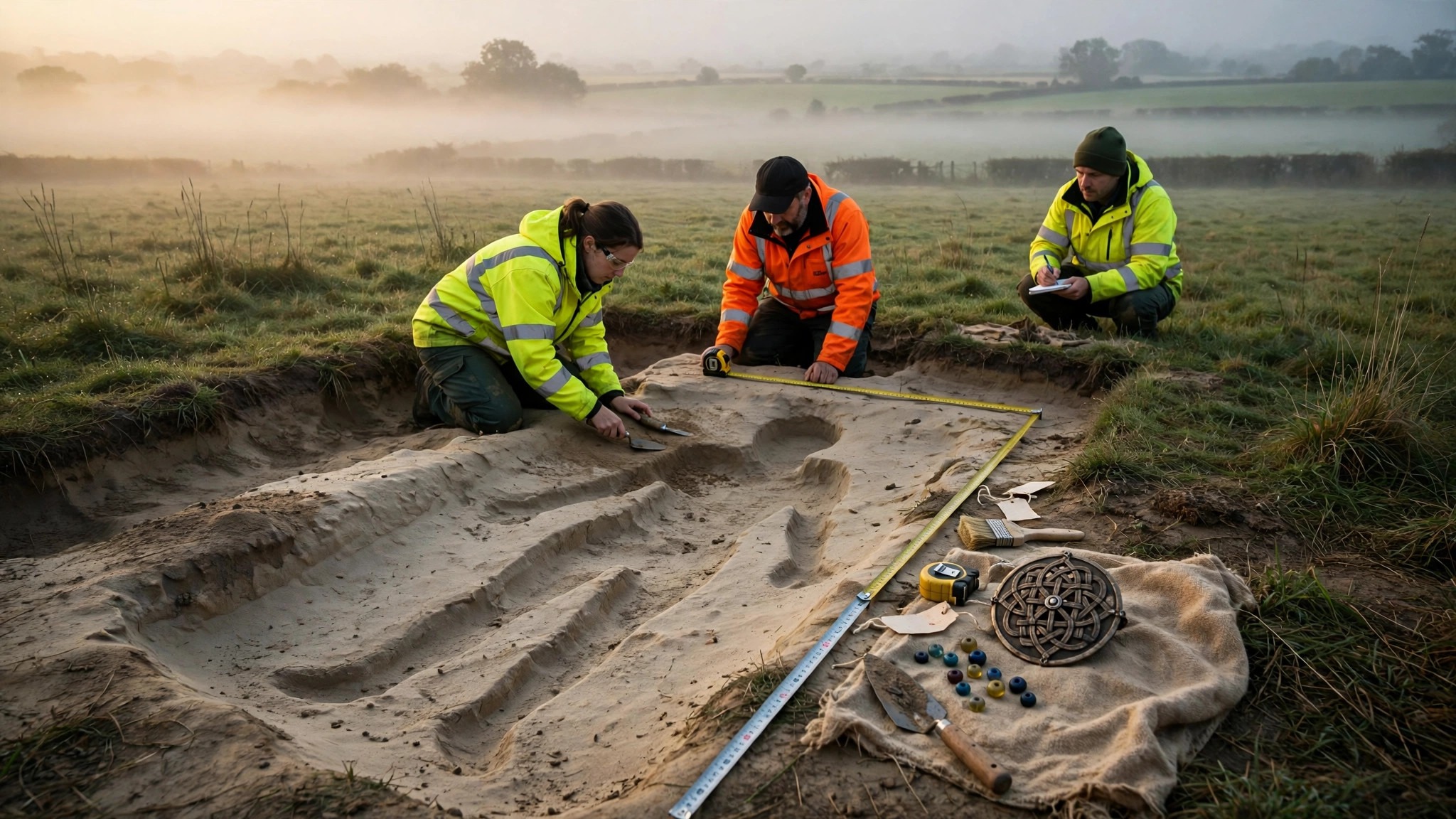
What the team found is known as a “sand body”. Sutton Hoo’s soil is acidic. Over hundreds of years, it dissolved the flesh and bones of the buried person completely. But as the body decayed, the surrounding sand hardened and held the person’s form — leaving a ghost-like impression in the ground, a negative image of the human body that once lay there. Angus Wainwright, an archaeologist with the National Trust, described it as one of the strangest features of the Sutton Hoo excavations: bodies and bones “dissolved away in the acid soil, replaced by hard sand which held the form of the person”. He called finding another one in Garden Field a high point of the latest dig.
Sand bodies are not new at Sutton Hoo. Archaeologists working at the site in the 1980s found similar human forms in the spaces between the mounds, appearing as areas of harder, darker sand. The new grave joins that small, unusual group — and it is the first sand body found in Garden Field.
The Grave Goods: An Ordinary Person’s Belongings
Buried with the sand body were four kinds of objects: a brooch, a knife, tweezers and beads. That short list is important for what it does not contain. There is no gold, no sword, no helmet, no silver — nothing like the famous treasures of the 1939 ship burial. These are the belongings of an ordinary person, not a royal one.
Still, small objects can say a lot. Here is what each find can tell researchers:
- The brooch — a personal item, probably worn on clothing. Its style and material can help date the burial and may hint at the person’s status and connections.
- The knife — a common, practical tool in Anglo-Saxon life, carried by men and women alike. Its presence is normal, not exceptional, which is itself informative.
- The tweezers — a grooming tool. Anglo-Saxons cared about personal appearance, and tweezers turn up regularly in graves of this period.
- The beads — small glass or stone beads, likely from a necklace or sewn onto clothing. Beads were traded across long distances, so their material may reveal trade links.
None of these objects can name the person. But together they sketch a life: someone who dressed, groomed, ate and worked in the villages and farms of the river valley around Sutton Hoo — the everyday East Anglians whose world surrounded the royal cemetery. The history of Christmas traditions we still follow every December shows how ordinary customs can survive for centuries: https://curioustown.com/history-of-christmas-traditions/
Why the Sutton Hoo Grave Matters: Kings vs Ordinary People
For almost 90 years, Sutton Hoo has been a story about kings. The 1939 ship burial — a 27-metre-long ship buried under a mound, filled with a helmet, shield, sword, gold buckles and silver from as far away as Byzantium — is often linked to Raedwald, a king of East Anglia, though that identification has never been proven. It made Sutton Hoo one of the most important archaeological sites in Britain. Small finds can carry outsized stories, much like the medieval chain mail found on the Gribshunden shipwreck.
Garden Field changes the balance. Excavations in 2024 began digging this burial ground, which researchers think may predate the famous ship burial. That season turned up the base of an intricately decorated sixth-century container known as the Byzantine Bromeswell Bucket. Earlier work in 2000 recorded 13 cremations and nine burials there. The team returned in June 2025 to learn more about how big the cemetery was, when it was used, and whether the people buried there were connected to the communities around the royal burial ground.
The new grave is the clearest answer yet. As Wainwright put it in the announcement, “this excavation moves the focus to these people and their ancestors and descendants.” The landscape around the royal mounds, he said, was just as familiar to the everyday East Anglians who lived in the villages and farms of the river valley. The Sutton Hoo grave does not identify a king or rewrite the ship burial. It does something quieter and just as valuable: it reminds us that the royal cemetery stood in a living landscape, full of ordinary people who buried their dead nearby.
The Mystery Below: Is There a Second Burial?
The grave holds one more surprise — and it is still only a suspicion. Evidence found directly beneath the sand body suggests that a second person may have been buried in the same grave. Whether the two people were buried together at the same time, or years apart, is not yet clear, and researchers will need to examine the evidence more closely before drawing any conclusions about their relationship.
The same caution applies to another lead from the dig. Near the River Deben, the team explored a field where an earlier survey had picked up something unusual underground. A more detailed scan suggested it might have the shape of a boat. But that is only one possibility: the feature could equally be a medieval dock, a 19th-century saw pit, or a modern cattle grave. Time Team’s Anglo-Saxon specialist, Dr Helen Geake, said the project is also chasing a long-standing puzzle — why and when the mound cemetery was placed on this particular ground. For now, both the possible second burial and the possible boat remain open questions, not discoveries.
Quick Guide: The Sutton Hoo Grave Discovery at a Glance
| Fact | Detail |
|---|---|
| What was found | A “sand body” — a ghost-like human shape in hardened sand, with no bones surviving, plus a brooch, knife, tweezers and beads |
| Where | Garden Field cemetery, Sutton Hoo, Suffolk, England — separate from the royal mounds and the 1939 ship burial |
| Found | During the summer 2025 dig (19 May–15 June 2025); announced November 2026 |
| Found by | Time Team, with the National Trust and FAS Heritage |
| Why no bones survive | Acidic soil dissolved flesh and bone; the sand hardened and kept the body’s shape |
| The big question | Evidence suggests a second person may be buried beneath the first — suspected, NOT confirmed |
| What the Sutton Hoo grave reveals | It shifts focus from kings to ordinary Anglo-Saxons, and shows Garden Field was an active cemetery |
| What it does NOT do | It does not identify a king, and it is not a second ship burial |
| Where to watch | Time Team’s new four-part series about the 2025 dig, first episode free on YouTube from 14 November 2026 |
| Next steps | Further digging and analysis to test the second-burial evidence and date the cemetery |
History’s biggest puzzles often mix solid evidence with unproven claims. Our timeline of the JFK assassination shows how official records, new evidence and disputed stories can sit side by side for decades before the picture becomes clear: https://curioustown.com/jfk-assassination-november-22-1963-timeline/
FAQs
What is a Sutton Hoo sand body?
A sand body is a burial where the body and bones have dissolved away in acidic soil, leaving a hardened sand impression that holds the shape of the person. At Sutton Hoo, the acidic ground rotted away flesh and bone over centuries, but the surrounding sand set into a solid, ghost-like outline of the body. Similar sand bodies were first found at Sutton Hoo during excavations in the 1980s, and the new grave is the latest example, found in the Garden Field cemetery.
When was the new Sutton Hoo grave found?
The grave was found during a month-long excavation in the summer of 2025, which ran from 19 May to 15 June 2025. The discovery was announced in November 2026, alongside the release of a new four-part Time Team documentary series about the dig. It was not discovered in November 2026 — that is only when the news became public.
What was buried with the person in the Sutton Hoo grave?
Archaeologists found a brooch, a knife, tweezers and beads with the sand body. These are ordinary personal belongings, not royal treasure. They suggest the person was an everyday Anglo-Saxon rather than a king or noble, which is itself interesting: it tells us about the ordinary people who lived around Sutton Hoo, not just its rulers.
Is the new grave connected to the famous 1939 ship burial?
No — the new grave is in Garden Field, a separate cemetery away from the famous royal mounds and the ship burial ground. The 1939 ship burial is a seventh-century royal grave, often linked (but never proven) to King Raedwald of East Anglia. Garden Field may even predate the royal mounds, and its burials seem to belong to the wider community around Sutton Hoo rather than to kings.
Is there really a second person buried in the same grave?
That is suspected but not confirmed. Evidence found beneath the sand body suggests a second person might have been buried in the same grave, but researchers do not yet know whether the two were buried together or at different times. More digging and analysis are needed before anyone can say for sure, so the double burial should be treated as a possibility, not a fact.
Why is the Sutton Hoo grave discovery important?
It shifts the story of Sutton Hoo from kings to ordinary people. For almost 90 years the site has been famous for royal treasure, but the new grave shows that the landscape around the royal mounds was home to farming families and village communities with their own burial ground. It helps archaeologists understand who lived in the region, how they buried their dead, and whether they were connected to the people of the royal cemetery.
Conclusion
The Sutton Hoo grave is a small, quiet discovery with a large meaning. No bones, no gold, no king — just a human shape held in sand and a few everyday objects: a brooch, a knife, tweezers, beads. Yet that is precisely the point. Sutton Hoo was never only a royal cemetery. It stood in a living landscape of farms and villages, and this grave finally gives a voice to one of the ordinary people who lived there. The second burial below may or may not be real, and the boat-shaped feature by the river may or may not be a ship — but the sand body itself is certain, and it has already changed what Sutton Hoo means.
Sources
- Smithsonian Magazine, “Almost 90 Years After Discovering a Ship Burial That Rewrote British History, Archaeologists Returned to Sutton Hoo. This Time, They Uncovered a Ghostly ‘Sand Body'” — https://www.smithsonianmag.com/smart-news/almost-90-years-after-discovering-a-ship-burial-that-rewrote-british-history-archaeologists-returned-to-sutton-hoo-this-time-they-uncovered-a-ghostly-sand-body-180989932/
- Arkeonews, “New Anglo-Saxon Grave Found at Sutton Hoo Beyond the Royal Mounds” — https://arkeonews.net/new-anglo-saxon-grave-found-at-sutton-hoo-beyond-the-royal-mounds/
- Ancient Origins, “Sutton Hoo’s Garden Field Gives Up a Rare Anglo-Saxon Sand Body” — https://www.ancient-origins.net/comment/48681
- Bury Times, “‘Mysterious’ Anglo-Saxon grave discovered at Sutton Hoo” — https://www.burytimes.co.uk/news/national/26743651.mysterious-anglo-saxon-grave-discovered-sutton-hoo/
- Times of India, “At England’s famous Sutton Hoo burial ground, archaeologists uncovered a ghost-like outline of an Anglo-Saxon body in sand” — https://timesofindia.indiatimes.com/science/archaeology/archaeologists-unearth-ghostly-outline-of-anglo-saxon-body-at-sutton-hoo-unveiling-ancient-mysteries-and-buried-treasures/articleshow/136133618.cms