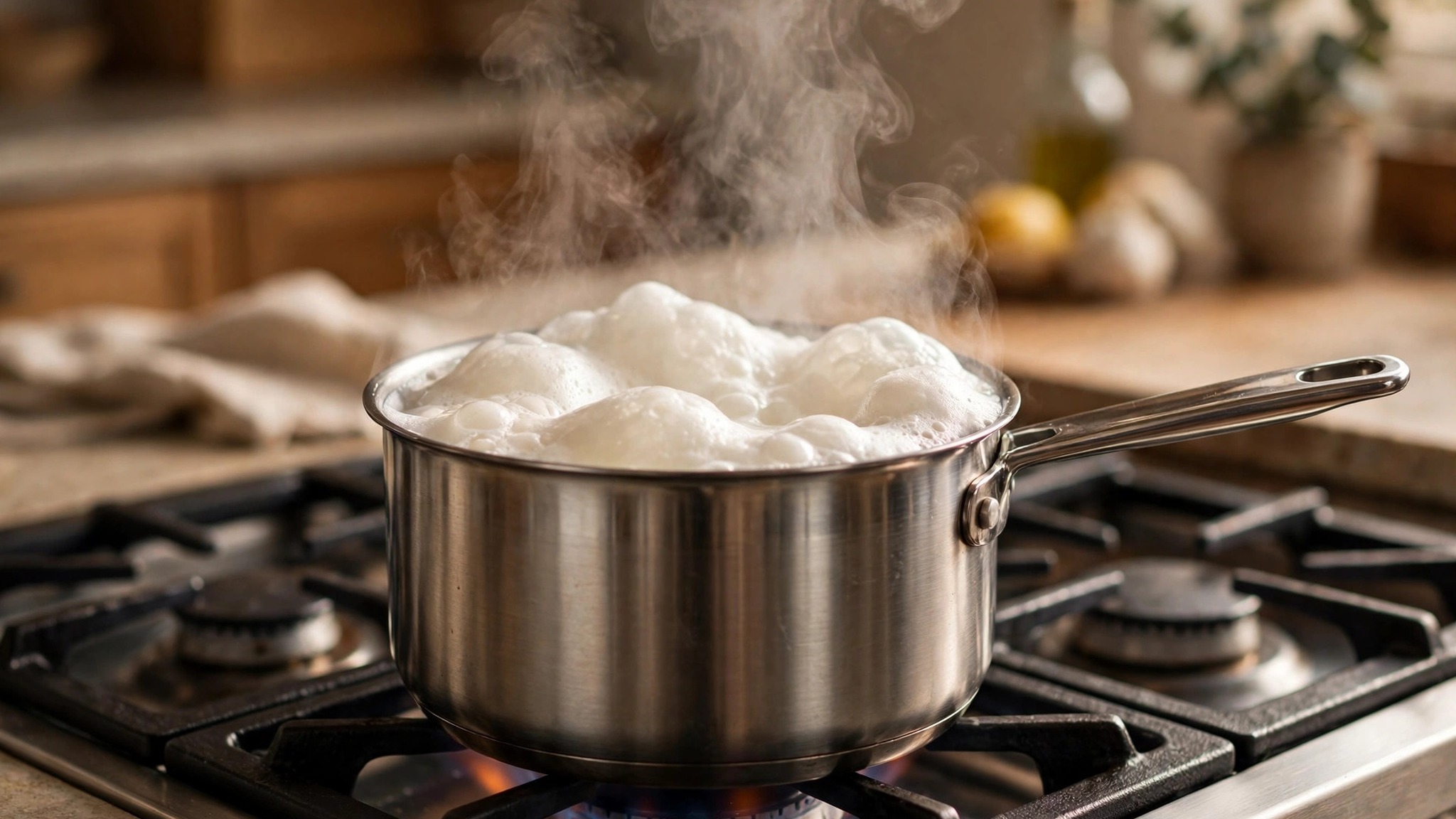
Why Does Milk Curdle and Boil Over? The Science Explained
You have probably seen it happen in your own kitchen: a carton of milk that smelled fine yesterday suddenly pours out in lumpy clots, or a quiet pan of milk erupts over the stove the second you look away. So why does milk curdle — and why does it boil over so much more dramatically than water? The answer comes down to one family of proteins, a little acid, and a thin skin that milk builds on its own surface.
Once you understand the chemistry, both mysteries make sense — and you can put them to work: the same process that ruins a carton turns milk into cheese and yogurt.
What’s Actually in a Glass of Milk?
A typical glass of whole cow’s milk is about 87–88% water, with fat (about 3.5–4%), lactose (about 5%), minerals such as calcium, and proteins (about 3.2–3.5%).
- Casein (about 80% of milk protein). Casein molecules gather into tiny spherical bundles called micelles, held together by calcium phosphate. A negative electric charge on their surfaces keeps the micelles apart — like the same poles of two magnets — which keeps milk smooth and liquid.
- Whey proteins (about 20% of milk protein). These smaller proteins — mainly beta-lactoglobulin and alpha-lactalbumin — float freely in the milk’s watery part. They are far more sensitive to heat than casein, and they drive the boil-over.
Why Does Milk Curdle? The Casein Story
Curdling happens when the casein micelles stop repelling each other and start clumping together. Near milk’s natural pH of about 6.6–6.7, the micelles keep their negative charge and stay apart — but lower the pH far enough and the charge disappears, the micelles stick together, and visible lumps form, leaving thin whey behind.
The magic number is pH 4.6 — the isoelectric point of casein, where the protein carries no net charge at all. At pH 4.6 casein is at its least soluble, so it drops out of solution and forms a curd. Anything that pushes milk toward that number will curdle it: souring bacteria, lemon juice, or vinegar.
The Bacteria Behind Sour Milk
Left at room temperature, milk is a feast for lactic acid bacteria — the same microbes used to make yogurt. They eat lactose and release lactic acid, and as the acid builds up the pH falls from about 6.7 toward 4.6. Once it crosses that line, the casein precipitates and the milk curdles. Refrigeration slows the bacteria, and pasteurisation — about 72 °C (161 °F) for 15 seconds — kills most but not all.
Heat, Acid and the Kitchen Curdle
Heat alone rarely curdles fresh milk, because casein is remarkably heat-stable. But heat plus acid is a different story. Add lemon juice or vinegar to hot milk, as when making paneer, and the curd forms almost instantly: heat unfolds the whey proteins, which bond onto the casein micelles, and the acid drives the pH down to 4.6. This is also why milk sometimes curdles in hot coffee or tea — coffee is acidic (around pH 5), and very hot coffee can tip borderline milk, a day or two from souring, over the edge.
Why Does Milk Boil Over? The Skin That Traps Steam
Boiling over has a different culprit: the skin. As milk heats, water evaporates from the top, concentrating proteins and fat there, while the whey proteins unfold — alpha-lactalbumin from around 62 °C, beta-lactoglobulin from around 75 °C — and stick to each other and to fat. The result is a thin film across the surface: the skin on hot milk, known as malai in South Asian cooking.
Meanwhile, at the bottom of the pan, water is turning into steam. In plain water, the bubbles rise and pop at the surface. In milk, they meet the skin and get coated in sticky proteins that make each bubble wall tougher — the same reason milk froths so well for coffee. Instead of popping, the bubbles pile up under the skin into a thick foam. The foam lifts the skin, more steam arrives, and within seconds the mass climbs the pan and spills over the rim — just as the milk reaches boiling point, about 100.2 °C (212.4 °F).
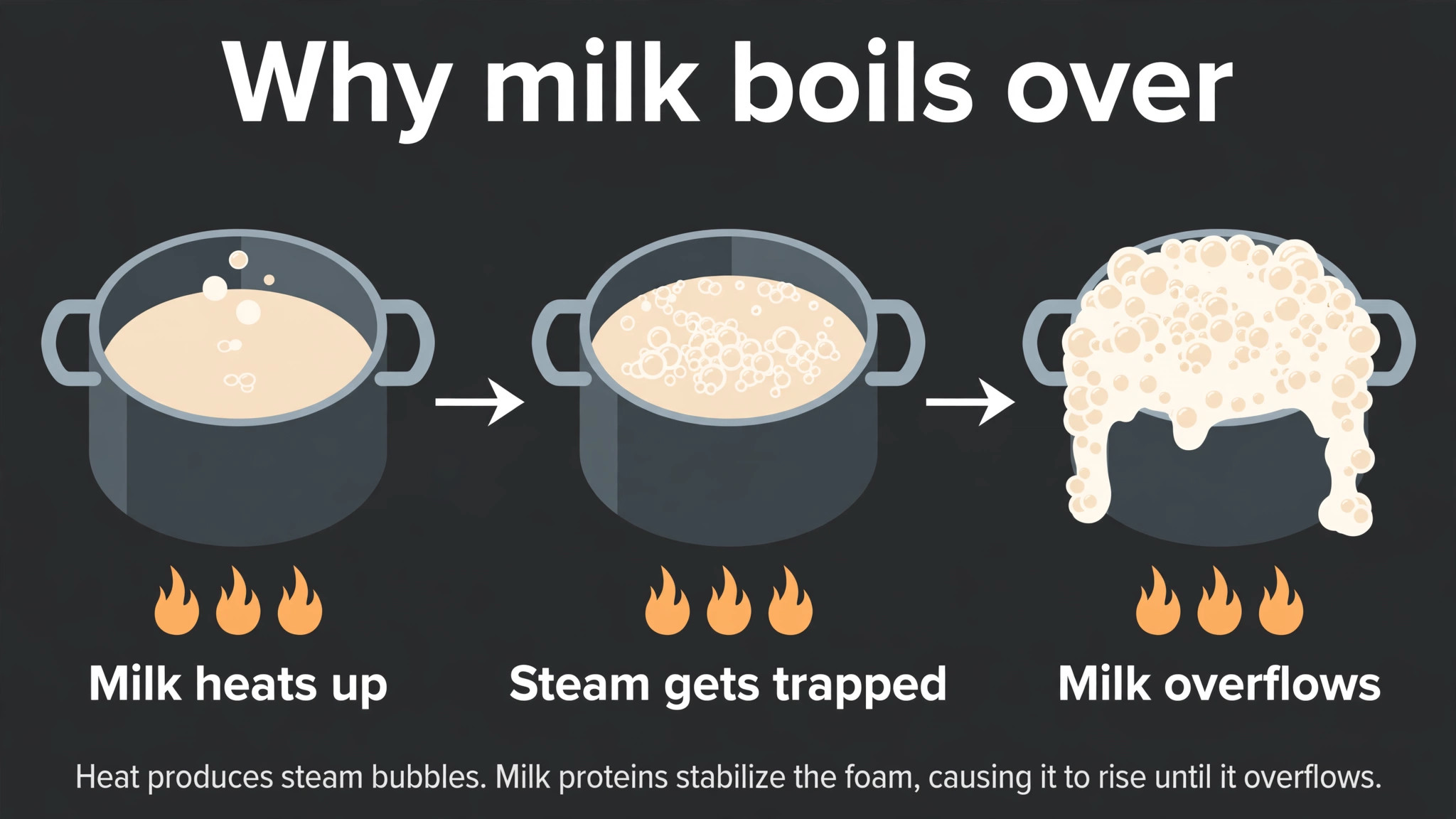
Milk vs Water: Why Only One Boils Over
Milk can build itself a lid, and water cannot. In milk, protein-coated bubbles survive and stack into foam; in water, they pop at once. Water boils at 100 °C (212 °F), milk at about 100.2 °C (212.4 °F) — and water warns you by bubbling steadily, while milk looks calm until the foam rises.
Quick Guide: How Different Milks Curdle and Boil Over
Not all milks behave the same on the stove. Dairy milks contain casein, so they truly curdle; plant milks contain none, so they split or separate instead.
| Type of milk | Protein (per cup) | Fat | Curdles? | Boils over? |
|---|---|---|---|---|
| Whole cow’s milk | ~8 g | ~8 g | Yes — at pH 4.6 | Yes — thick foam |
| Skimmed cow’s milk | ~8 g | ~0 g | Yes — same casein | Yes, but less foam |
| Goat’s milk | ~8 g | ~8 g | Yes | Yes — like cow’s milk |
| Buffalo milk | ~9 g | ~10 g | Yes | Yes — very thick skin |
| Soy milk | ~7–8 g | ~4 g | Splits in acid/heat | Less foam |
| Oat milk | ~2–3 g | ~3 g | Rarely | Rarely — thin foam |
| Almond milk | ~1 g | ~2–3 g | Splits in hot coffee | Rarely |
Higher protein means a stronger skin and more dramatic boil-overs — whole and buffalo milk are the worst offenders. Plant milks are generally safer, though soy milk can still split in very hot coffee.
Curdling on Purpose: Cheese and Yogurt
Curdling is not always an accident — humans have done it deliberately for thousands of years, and some favourite foods are just controlled curdling.
- Yogurt: Milk is warmed with a starter culture of lactic acid bacteria, usually Lactobacillus bulgaricus and Streptococcus thermophilus. Over several hours they turn lactose into lactic acid, the pH falls to about 4.6, and the casein forms a soft gel.
- Cheese: Most cheeses add an enzyme called rennet (chymosin), traditionally from a calf’s stomach and now usually made by fermentation. Rennet snips a piece off the kappa-casein on the micelles’ surface, removing the layer that keeps them apart, so they clump into a firm curd. Acid cheeses such as paneer and ricotta skip the rennet and rely on acid alone.
- Paneer and ricotta: Heat the milk, add lemon juice or vinegar, and the curd separates from the whey before your eyes — the simplest curdling of all.
The difference from a ruined carton is control. The chemistry is identical — only the conditions are managed.
How to Stop Milk Boiling Over: Practical Tips
You cannot change milk’s chemistry, but you can break the chain — fewer bubbles, a broken skin, or room for the foam.
- Use a bigger pan. Leave plenty of headroom so the foam has somewhere to go.
- Keep the heat low and stir often. Stirring breaks up the skin, letting steam escape in small bursts. Never walk away from milk on high heat.
- Take it off the heat just before it boils. Milk is ready at around 80–85 °C for most cooking.
- Lay a wooden spoon across the pot. This folk remedy sometimes helps, by breaking the foam’s surface. It is not a guarantee.
- Add a pinch of baking soda to acidic dishes. With tomatoes or other acidic ingredients, a tiny pinch raises the pH slightly.
- Use a milk watcher. These small discs sit in the pan’s bottom and rattle loudly when the milk starts to boil.
If it does boil over, turn the heat off and clean the spill while it is warm — burnt milk hardens into a crust that is far harder to scrub once cool.
Spoiled Milk vs Safely Curdled Milk: How to Tell the Difference
Curdled does not automatically mean dangerous. Safely curdled milk curdled under controlled conditions — lemon juice in hot milk for paneer, or live cultures for yogurt — and smells tangy, like yogurt, not rotten.
Spoiled milk soured on its own, because uninvited bacteria grew in it over days. It smells sharply sour or rancid, and may carry bacteria that cause stomach upsets. Milk that has curdled inside its carton — especially past its use-by date or left out of the fridge — should be thrown away: boiling kills many bacteria but will not remove toxins some produced. If you curdled it on purpose, enjoy it. If it curdled itself, bin it. Winter complicates everyday routines beyond the kitchen — cold, dark mornings are why it is so hard to wake up in winter, and the same dry winter air can leave your skin feeling oily but dry.
Frequently Asked Questions (FAQs)
Why does milk curdle when heated?
Heat plus acid pushes milk’s casein proteins to pH 4.6, their isoelectric point, where they lose their charge and clump together. Heat alone rarely curdles fresh milk — but add lemon juice, vinegar, coffee or tomato and the curd forms fast.
Why does milk boil over but water doesn’t?
Milk’s proteins and fat form a thin skin that traps rising steam, turning it into stable foam that climbs the pan and spills. Water has no proteins or fat, so it forms no skin — its bubbles pop and the steam escapes.
Is curdled milk safe to drink?
It depends on how it curdled. Milk curdled deliberately — with lemon juice for paneer, or by live cultures for yogurt — is safe to eat. But milk that curdled on its own in the carton, especially past its use-by date, should be thrown away: it may carry germs boiling will not remove.
Why does milk curdle in coffee or tea?
Coffee and tea are mildly acidic, and very hot liquid speeds up the reaction. If the milk is a few days old, its pH has drifted toward 4.6, so the coffee’s acid pushes it over the edge. Fresher milk in slightly cooled coffee is much less likely to split.
Does skimmed milk boil over less than whole milk?
Slightly, but it still boils over. Skimmed milk has the same casein and whey proteins, so it still forms a skin and traps steam — but with almost no fat, the skin is thinner and the foam less rich. Never leave it unattended.
Why does milk form a skin when heated?
Heat unfolds the whey proteins — alpha-lactalbumin from around 62 °C, beta-lactoglobulin from around 75 °C — and they stick to each other and to fat, gathering at the surface as water evaporates. The result is a thin film of denatured protein and fat, which thickens into malai as it cools.
Can you stop milk from curdling when cooking?
Yes, in most cases. Use the freshest milk you can, keep the heat low, add acidic ingredients gradually at the end of cooking, and stir constantly. A pinch of baking soda raises the pH slightly, and a little flour or cornstarch coats the proteins and keeps them apart.
Why does milk curdle in the fridge before its expiry date?
Milk can sour before its date if stored badly — left out, kept in the fridge door where temperatures swing, or poured back into the carton. Pasteurisation kills most bacteria, but the survivors keep making lactic acid, driving the pH toward 4.6.
Conclusion
Why does milk curdle, and why does milk boil over? Because milk is a chemical system built around casein proteins. A little acid drops the pH to 4.6 and the casein clumps into curds; a little heat unfolds the whey proteins into a skin, the skin traps steam, and the foam climbs out of the pan. Understand those two mechanisms and you can prevent the accidents — and use the same chemistry for yogurt and cheese.
Sources
- Amrita Virtual Lab — Isoelectric Precipitation of Proteins: Casein from Milk
- ScienceABC — Why Does Milk Spill Upon Boiling, But Water Doesn’t?
- Fermi News — Why milk boils over but water doesn’t: the skin that traps steam
- Crazy for Chem — Chemistry of Curd Formation: How Lactobacillus Works
- Provenance Kitchen — Acid Coagulation of Dairy — Cheesemaking and Paneer
- Harold McGee — On Food and Cooking: The Science and Lore of the Kitchen (Scribner, 2004), chapter on milk