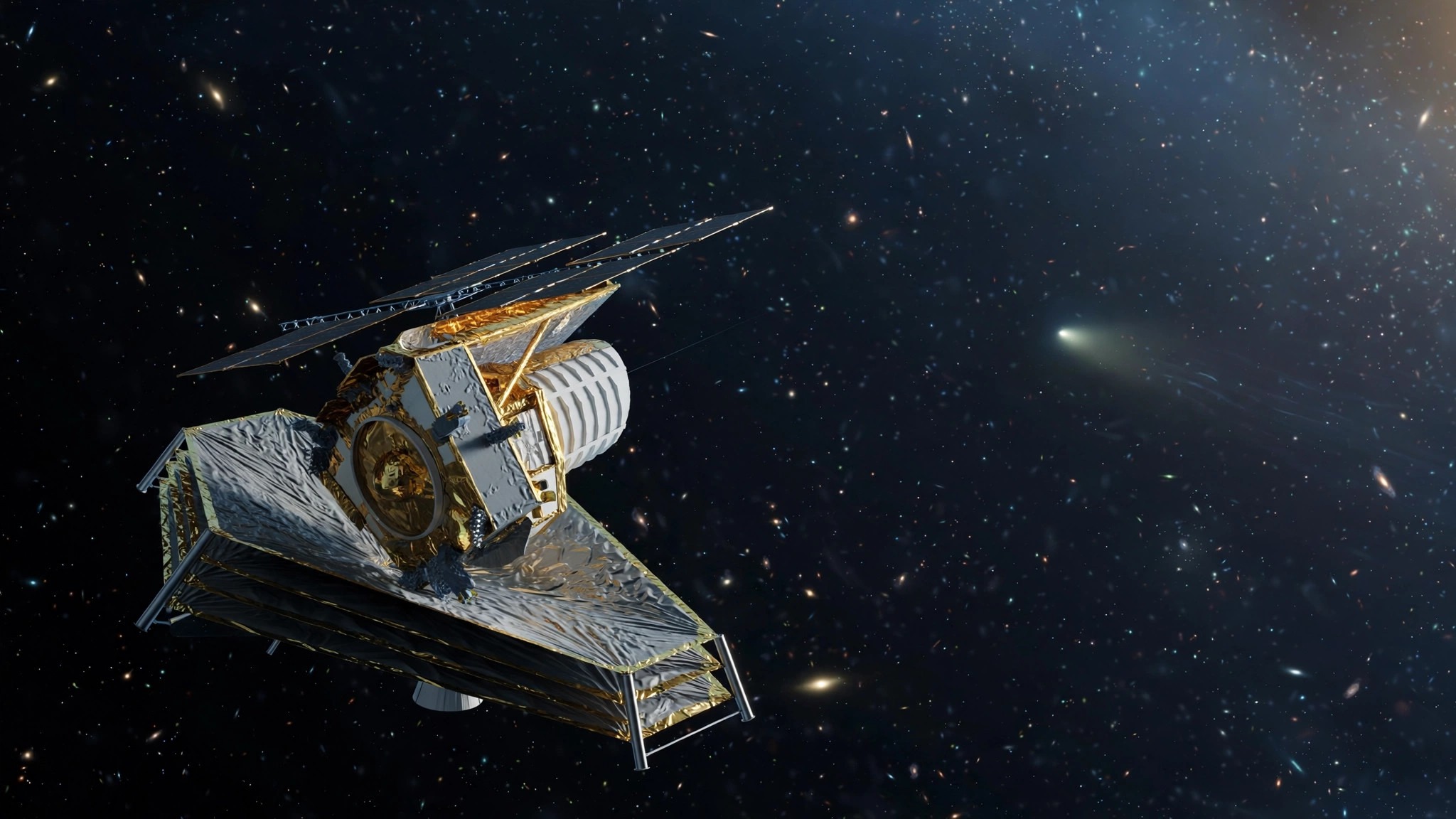
C/2026 S1 Euclid: The Unexpected Comet That Takes Thousands of Years to Orbit the Sun
A space telescope built to photograph distant galaxies has just found something much closer to home. It is also far older than anyone expected. The Euclid comet discovery, announced by the European Space Agency, is the first previously unknown comet ESA’s Euclid telescope has ever spotted. It is a faint, icy visitor called C/2026 S1 (Euclid). It drifts about 1.3 billion kilometres (808 million miles) from Earth, on an orbit that takes thousands of years to complete.
No one ever expected to find the comet at all. Euclid exists to map the dark Universe, not chase Solar System objects. It deliberately avoids the part of the sky where comets and asteroids are most common. Yet in images taken between 16 and 24 September 2026, a small streak of light gave it away. Within weeks, astronomers around the world had confirmed that humanity had a brand-new comet on its hands.
A Galaxy Telescope That Wasn’t Looking for Comets
Euclid launched to answer one of the biggest questions in science: what are dark matter and dark energy, the invisible forces shaping the Universe? Over six years, it is mapping the shapes and motions of billions of galaxies out to 10 billion light-years away. That is a job for deep, steady images of the far Universe. It is not for tracking fast-moving rocks and ice balls in our own Solar System.
In fact, Euclid’s observing strategy works against comet hunting in three ways:
- It avoids the ecliptic plane. Euclid deliberately stays away from the band of sky along the Solar System’s plane, where asteroids and comets are most common. Dust there scatters sunlight and would blur its sensitive galaxy images.
- It visits each patch of sky once. Euclid’s “step-and-stare” strategy typically images each section of sky only a single time. A moving object cannot simply be revisited on demand to confirm what it is.
- It holds still for up to 10 minutes per position. The telescope keeps the stars fixed in its field of view. Anything moving through the Solar System smears into a streak.
That last quirk turned out to be the key. A comet crossing Euclid’s view during a long exposure leaves a tell-tale streak — and a piece of software written to look for exactly those streaks caught one.
How the Euclid Comet Discovery Was Made
The discovery belongs to Mikko Pöntinen, a PhD student at the University of Helsinki, who developed moving-object detection software to monitor small Solar System objects in Euclid’s images. Working with the Euclid Consortium’s Solar System Objects Science Working Group, he spotted the streak in images from the Euclid Deep Field North survey. That survey covers a patch of sky in the constellation Draco.
“I was excited to see my software flag a ‘streak’ smeared across several images — the result of a fast-moving object,” Pöntinen said. “By predicting its position I could identify it in other images, in total finding it in five image sets. Further inspection revealed that it had a fuzzy cloud around it, indicative of an active object like a comet that is shedding dust and gas.”
Euclid Comet Discovery: From Streak to Confirmation
That fuzzy cloud was the giveaway. Known as a coma, it forms when a comet’s ice warms and releases gas. The gas carries dust into space around the solid nucleus. Asteroids do not usually show one. The timeline of the discovery went like this:
- 16–24 September 2026: Euclid photographs the comet during its Deep Field North survey. The clearest single image, taken on 20 September, is a 560-second exposure. In it, the comet appears as a streak surrounded by its coma.
- Late September 2026: Pöntinen’s software flags the streak. He tracks it across five image sets: 16 exposures in total. He confirms the fuzzy cloud.
- Catalogue check: The team compares the object’s position against every known comet and asteroid. There is no match. It is genuinely new.
- Report to the Minor Planet Center: Pöntinen reports the observations to the International Astronomical Union’s Minor Planet Center (MPC). The MPC is the global clearing house for comet and asteroid sightings. Ground-based astronomers rush to make follow-up observations.
- 8 October 2026: The MPC officially confirms the discovery. The comet is designated C/2026 S1 (Euclid).
It is worth noting that Euclid had detected comets before — but every one of them was already known. C/2026 S1 is the first new comet the telescope has ever discovered.
An Orbit That Defies Imagination
C/2026 S1 sits about 1.3 billion kilometres from Earth — roughly the distance from the Sun to a point between the orbits of Jupiter and Saturn. But it is not sitting between the planets. It is currently far above the plane in which the planets orbit. From the Sun’s point of view, it is almost “straight up”. It arcs over the Solar System on an orbit that is nearly perpendicular to the planets’ paths.
And that orbit is enormous. ESA describes it simply: it “takes thousands of years to complete.” The Euclid Consortium has refined that into a more specific estimate. The comet will swing out to 9,786 astronomical units from the Sun. One astronomical unit is the Earth–Sun distance. That is about 1.5 trillion kilometres. It will not return to the inner Solar System for roughly 345,000 years. That refined figure is an estimate from the orbit calculation, not a settled measurement. The official ESA wording remains “thousands of years.”
To put that in perspective, the Consortium notes that the comet’s last visit to the inner Solar System happened during the late Middle Pleistocene. Woolly mammoths, aurochs and forest rhinos roamed central Europe then. Neanderthals were being displaced by the coming ice age. Our own Homo sapiens ancestors were living as hunter-gatherers in northern Africa. By the time C/2026 S1 comes back, Earth will be a very different planet.
Quick Guide: C/2026 S1 (Euclid) at a Glance
| Fact | Detail |
|---|---|
| Official designation | C/2026 S1 (Euclid) |
| Discovered by | Mikko Pöntinen, University of Helsinki, with the Euclid Consortium’s Solar System Objects Science Working Group |
| Images taken | 16–24 September 2026, Euclid Deep Field North (Draco) |
| Confirmed by | International Astronomical Union’s Minor Planet Center, 8 October 2026 |
| Distance from Earth | About 1.3 billion km (808 million miles) |
| Distance from the Sun | Roughly between the orbits of Jupiter and Saturn — but far above the planets’ plane |
| Orbit | Near-perpendicular to the planets; takes thousands of years (ESA); Consortium’s refined estimate ~345,000 years |
| Farthest point from the Sun | 9,786 AU — about 1.5 trillion km, or 0.15 light-years |
| Origin | The Oort Cloud, the distant shell of icy bodies beyond the planets |
| Visible to the naked eye? | No — far too dim, even for most amateur telescopes |
| Why it matters | First new comet found by Euclid; a real-world test for finding distant comets early |
Like C/2026 S1, asteroid 2026 QQ8 — Earth’s temporary mini-moon was also far too faint to see with the naked eye.
What Is the Oort Cloud?
C/2026 S1 comes from the Oort Cloud, the most distant region of our Solar System. It is a vast, roughly spherical shell of icy bodies far beyond the orbits of Neptune and Pluto. Here is what makes it special:
- It is enormous and mostly empty. Scientists estimate there could be as many as one trillion comets in the Oort Cloud. They are spread across a shell so large that light takes months to cross it.
- Comets are ancient leftovers. Comets are icy, dusty remnants from the birth of the Solar System about 4.6 billion years ago. Because they have changed so little since they formed, studying them reveals the raw ingredients that built the planets. Those ingredients include clues about where Earth’s water and the building blocks of life may have come from.
- Very few have ever been seen. Of that trillion, only 4,644 comets have ever come close enough to the Sun to be observed by humans. Only around 500 are “numbered” short-period comets, seen returning at least twice.
- C/2026 S1 is a long-period visitor. Halley’s Comet returns every 76 years. C/2026 S1 will spend hundreds of thousands of years in the deep freeze of the outer Solar System before its next visit.
In other words, this comet is a messenger from the very edge of the Sun’s influence. It is a piece of the Solar System’s original building material, preserved in cold storage for billions of years.
Why the Euclid Comet Discovery Matters for Future Missions
C/2026 S1 itself is not a target for any spacecraft. ESA is clear about that: “While this particular comet is not a suitable candidate for Comet Interceptor, the process of discovery and alert gives us a real test case for how our two mission teams will coordinate in the future,” said Valeria Pettorino, Euclid Project Scientist.
That is the real significance of this find. ESA’s future Comet Interceptor mission is designed to wait in space for a pristine comet. Ideally, that comet will be making its first ever visit from the Oort Cloud. The mission will then fly out to meet it. To do that, astronomers need to find such comets while they are still far from the Sun. That gives the spacecraft time to intercept them. Euclid was never built for that job, but this discovery proves its data can do it.
Cleaning Up Euclid’s Galaxy Images
There is a practical reason, too. Tracking moving objects matters for Euclid’s main mission. Comet trails and stray light from asteroids are noise. Astronomers must remove that noise from its galaxy images. The same detection techniques that clean up the pictures can also flag new comets early. As Bruno Altieri, Euclid Archive Scientist and part of the discovery team, put it: “Very few comets are expected to be discovered by Euclid so it was a happy coincidence that the combination of the comet’s orbit and Euclid’s scanning over those days captured the object in multiple images.”
Euclid’s scientists will keep searching for more of these ancient messengers. Each one is a small, frozen time capsule from the birth of the Solar System. Now we know that a telescope built to look at galaxies can find them, too.
For a sky show you can actually watch, see our Geminid meteor shower 2026 guide. For ESA’s other close-up asteroid work, see how Hera revealed the stadium-size crater on Dimorphos after NASA’s DART impact.
Frequently Asked Questions (FAQs)
What is the Euclid comet discovery?
The Euclid comet discovery is the finding of C/2026 S1 (Euclid), the first previously unknown comet ESA’s Euclid space telescope has ever discovered. Mikko Pöntinen of the University of Helsinki spotted it in images taken between 16 and 24 September 2026. He used software he developed to detect moving objects in Euclid’s images. The International Astronomical Union’s Minor Planet Center confirmed it on 8 October 2026.
How far away is comet C/2026 S1?
Comet C/2026 S1 is about 1.3 billion kilometres (808 million miles) from Earth. That is roughly the distance from the Sun to a point between the orbits of Jupiter and Saturn. Yet the comet is not in the planets’ plane at all. It sits far above it, arcing over the Solar System on a near-perpendicular orbit.
How long does C/2026 S1 take to orbit the Sun?
ESA says the comet’s orbit “takes thousands of years” to complete. The Euclid Consortium’s refined calculation estimates a return in about 345,000 years. By then, the comet will have swung out to 9,786 astronomical units — about 1.5 trillion kilometres — from the Sun. That longer figure is a refined estimate, not a settled measurement. So the safest description is that the orbit takes thousands of years, possibly hundreds of thousands.
Can I see comet C/2026 S1 with a telescope?
No. C/2026 S1 is far too dim to see with the naked eye, and it is too faint for most amateur telescopes as well. Euclid found it only because it is an extremely sensitive space telescope taking very long exposures. This is a discovery to read about and marvel at — not one to go outside and look for.
Where does comet C/2026 S1 come from?
The comet comes from the Oort Cloud, the distant spherical shell of icy bodies at the edge of the Solar System. Its hugely elongated orbit stretches nearly 10,000 times farther from the Sun than Earth. That points to an origin in that far region. Comets from the Oort Cloud are among the most ancient objects in the Solar System, largely unchanged since it formed 4.6 billion years ago.
Why is this discovery important if the comet is so far away?
Because it proves Euclid can find new comets while they are still far from the Sun — exactly what ESA’s future Comet Interceptor mission needs. Comet Interceptor will wait in space for a pristine comet and fly out to meet it, but that only works if astronomers spot the comet early. This discovery was a successful dress rehearsal for that process. It shows a galaxy-mapping telescope can double as an early-warning system for ancient visitors.
Conclusion
The Euclid comet discovery is a reminder that the best finds are often the ones nobody planned for. A telescope built to map billions of distant galaxies caught a faint streak in the constellation Draco. That streak turned out to be C/2026 S1, a new comet from the Oort Cloud. It is on an orbit that takes thousands of years to complete. It will not return until long after our civilisation is gone. But its discovery has already changed how astronomers think about finding distant comets early. It hints that Euclid’s six-year survey may still hold a few more surprises from the edge of the Solar System.