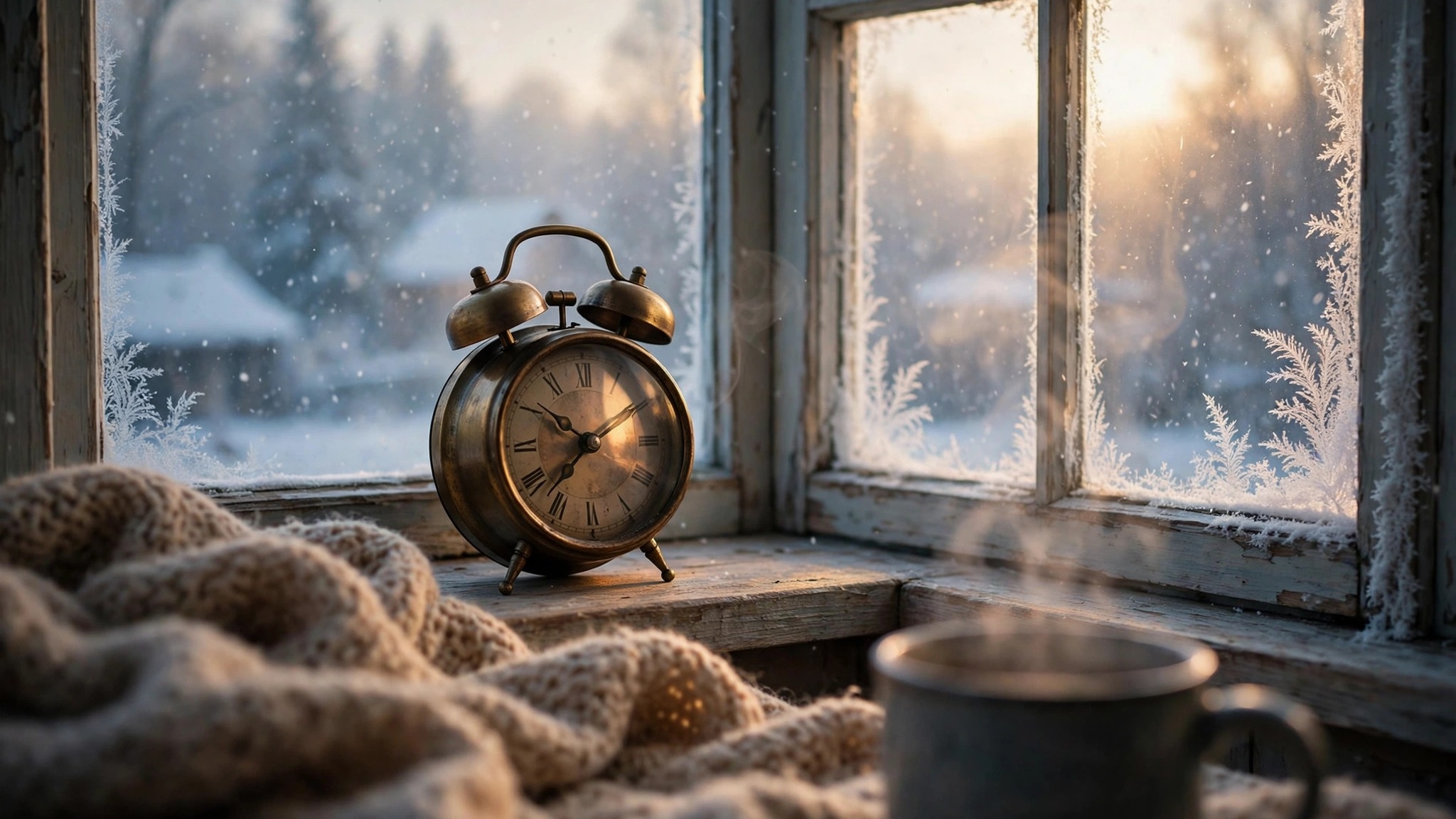
Why Is It So Hard to Wake Up in Winter? The Science Behind Your Body Clock
Your alarm goes off, but the room is still pitch dark. You know it is 7 a.m., your phone says so, yet your body is convinced it is the middle of the night — and honestly, it has a point. In December, the sun in much of the United States does not rise until after 7 a.m., so millions of people are dragging themselves out of bed hours before their brains have received a single real signal that morning has arrived.
This is not laziness, and it is not a character flaw. Waking up in winter is harder because your body clock runs on light, and winter takes most of that light away. Below is the science of why dark mornings feel so heavy — your circadian rhythm, melatonin, and the seasonal shift researchers can actually measure — plus seven practical morning habits that make getting up easier, and how to tell normal winter tiredness from something worth talking to a doctor about.
Your Body Clock Runs on Light
Your body keeps time with an internal clock called the circadian rhythm, a roughly 24-hour cycle that regulates sleep, hunger, body temperature, and hormone release. According to the US National Institute of General Medical Sciences (NIGMS), light and dark have the biggest influence on this rhythm — bigger than food, exercise, or willpower.
The clock lives in a small cluster of nerve cells in the brain called the suprachiasmatic nucleus, and it sets your sleep hormone melatonin according to how much light reaches your eyes. In the evening, as light fades, melatonin production rises and you feel sleepy. In the morning, light tells the brain to switch melatonin off, and the National Heart, Lung, and Blood Institute (NHLBI) notes that your body then releases cortisol, which prepares you to wake up.
Winter breaks that morning cue in two ways. First, the sun rises late, so the “wake up” light signal arrives later — or, on a dark commute, barely arrives at all. Second, you spend far more of the day indoors under artificial light, which is a weak daytime signal compared with real daylight. The result is a mismatch: your alarm stays put while the sun does not, and the clock on your phone and the clock inside your head disagree for weeks at a time.
5 Reasons Winter Mornings Feel Harder
- The sunrise comes late. In winter, sunrise in many US cities falls after 7 a.m., so your alarm rings before dawn. Without morning light, melatonin stays high and your brain keeps signalling that it is still night.
- Your biological night gets longer. In a 2017 study published in Current Biology, people who spent a week living by the natural winter light-dark cycle started their biological night — and their sleep — earlier than in their usual electrically lit lives, and their biological night expanded in winter compared with summer. Your body genuinely runs a longer “night” in the dark season.
- You sleep differently in winter. A 2023 sleep-lab study of 188 patients in Berlin found that REM sleep ran about 30 minutes longer in winter than in spring, and total sleep time was up to an hour longer. Even if you go to bed at the same time, your body may be asking for more sleep.
- You get far less daylight overall. In London, for example, the longest day of 2026 has 16 hours 38 minutes of daylight, while the shortest has just 7 hours 49 minutes — almost nine hours of light gone, most of it from the ends of the day, exactly when you are commuting or trying to get out of bed. Northern US cities see the same pattern on a slightly smaller scale.
- Dark, cold bedrooms work against you. A pitch-dark, chilly room is perfect for falling asleep and terrible for waking up. Heavy curtains, a cold floor, and a warm bed create a strong pull to stay put, right when your body clock is already running late.
Is It Just Winter Tiredness — or Something More?
For most people, harder winter mornings are a normal seasonal shift, and they ease as the days lengthen in spring. But the same lack of daylight sits behind a recognised condition called seasonal affective disorder (SAD), a type of depression that follows the seasons.
The NHS says SAD is thought to be linked to reduced daylight in winter, which may change brain chemicals like melatonin and serotonin and disrupt your circadian rhythm. Its symptoms include a persistent low mood, losing interest in things you usually enjoy, feeling irritable, difficulty concentrating, sleeping more than usual — and finding it hard to get up in the morning. The US National Institute of Mental Health (NIMH) adds that winter-pattern SAD typically lasts about four to five months of the year and is more common in people living farther north, where winter days are shortest.
The line between “winter tiredness” and SAD is about persistence and impact. The NHS advises seeing a GP if you think you might have seasonal affective disorder, or if you have felt tired for a few weeks and do not know why. This article is general health education, not medical advice, and it does not diagnose anything — but if low mood, lost interest, or exhaustion last for weeks, that is a conversation worth having with a doctor, not something to push through alone.
The NHS also lists everyday steps that support mood and sleep in winter: getting as much natural daylight as you can, exercising regularly — ideally outdoors in daylight — and keeping a routine. Light therapy, using a bright lamp that simulates daylight, is one of the treatments the NHS describes for SAD, but it is a treatment to discuss with a clinician, not a gadget to buy on impulse.
7 Morning Habits That Make Waking Up Easier
- Get bright light within 30 minutes of waking. Step outside, stand by a bright window, or open the blinds fully. Morning light is the strongest “daytime” signal you can give your body clock, and it is the single most effective habit on this list.
- Wake up at the same time every day. The CDC recommends going to bed and getting up at the same time every day, weekends included. A fixed wake time anchors your rhythm even when the sunrise keeps moving.
- Let the light in before the alarm. Leave the curtains partly open so the room brightens as the sun rises, or use a dawn-simulating alarm clock that slowly brightens the room before the sound starts. Waking to light is far gentler than waking to a buzzer in the dark.
- Move within the first hour. A short walk outside — even ten minutes — combines daylight, movement, and fresh air. The NHS recommends regular exercise outdoors in daylight as one of the best everyday supports for winter mood and sleep.
- Keep evenings dim and screens down. Bright light late at night, including from phones and TVs, can delay melatonin release and push your whole clock later. Dim the lights an hour before bed and keep the phone out of the bedroom if you can.
- Make the bedroom warm before you get up. A cold room is a powerful reason to stay under the covers. Set the heating to come on 30 minutes before your alarm, and put your slippers and robe within reach so the first minute out of bed is not a shock.
- Eat breakfast in the light. A regular breakfast eaten near a window, or after a short morning walk, gives your body a second “morning” signal — food and light together tell your clock the day has started. A warm, protein-rich breakfast beats a sugary one that leaves you crashing by 10 a.m.
For nights themselves, small supports can help too. Our guide to magnesium glycinate for sleep looks at what the 2025–2026 clinical research actually shows — a modest benefit for some poor sleepers, not a cure for insomnia. And if winter evenings leave you reaching for comfort food, the health benefits of pumpkin and pumpkin seeds make a seasonal snack that is genuinely nutritious rather than just sugary.
Quick Guide to Waking Up in Winter
| Problem | What Is Happening | What Helps Most |
|---|---|---|
| Alarm rings in darkness | Sun rises after your wake time, so melatonin is still high | Bright light within 30 minutes of waking |
| Grogginess lasts for hours | Your biological night runs longer in winter | Same wake time every day, even on weekends |
| You sleep longer but feel worse | REM sleep runs longer in winter; the clock is out of sync | Morning daylight and a short outdoor walk |
| Low mood and no energy for weeks | May be seasonal affective disorder, not just tiredness | See a GP; daylight, exercise, and routine help |
| Evenings stretch late | Bright screens delay melatonin and push sleep later | Dim lights and less screen time before bed |
Frequently Asked Questions (FAQs)
Why is it so hard to wake up in winter?
Because your body clock runs on light, and winter mornings have very little of it. Melatonin, the hormone that makes you sleepy, falls when morning light reaches your eyes — but in winter the sun rises late, so that signal arrives late or barely at all, and your brain keeps signalling that it is still night.
Does winter actually change how we sleep?
Yes, measurably. A 2017 study in Current Biology found that living by the natural winter light-dark cycle made the biological night start earlier and last longer than in summer. A 2023 Berlin sleep-lab study found REM sleep ran about 30 minutes longer in winter than in spring, and total sleep was up to an hour longer.
Is feeling tired all winter a sign of seasonal affective disorder?
Not necessarily — most winter tiredness is a normal seasonal shift. But if you also have a persistent low mood, lose interest in things you enjoy, sleep much more than usual, or feel exhausted for weeks, the NHS advises seeing a GP, because those can be signs of seasonal affective disorder.
Does a light box help with waking up in winter?
Light therapy — a bright lamp that simulates daylight — is one of the treatments the NHS describes for seasonal affective disorder, and morning bright light in general is the strongest cue for your body clock. A light box is a treatment device, though, so talk to a clinician before buying one, especially if you have an eye condition or take medication that increases light sensitivity.
What is the single best habit for easier winter mornings?
Get bright light as soon as you can after waking — ideally real daylight outside, or at least a bright window. It switches off melatonin, triggers the cortisol wake-up signal, and anchors your body clock for the whole day. Pair it with a fixed wake time and it beats any single gadget or supplement.
Conclusion
Waking up in winter is hard because your body is doing exactly what it evolved to do: following the light. When the sun rises late and the days are short, your melatonin stays high, your biological night runs long, and your alarm goes off before your brain has had its morning signal. None of that is a personal failing — it is your circadian rhythm responding to the season. The fix is not to fight the clock harder but to give it better signals: bright light first thing, the same wake time every day, movement outdoors, and dim evenings. And if the tiredness comes with a low mood that lasts for weeks, treat that as a reason to talk to a doctor, not to tough it out. Spring will bring the light back on its own — until then, a little daylight, taken on purpose, is the closest thing to a shortcut that exists.
Sources
- NHS — Seasonal affective disorder (SAD)
- National Institute of Mental Health — Seasonal Affective Disorder
- National Institute of General Medical Sciences — Circadian Rhythms
- National Heart, Lung, and Blood Institute — Why Is Sleep Important?
- Current Biology, 2017 — Living by the natural winter light-dark cycle
- Frontiers in Neuroscience, 2023 — Berlin sleep-lab study: REM sleep about 30 minutes longer in winter
- Centers for Disease Control and Prevention — Sleep and sleep disorders: keep a regular sleep schedule
- Sleep Health Foundation Australia — Winter is coming: less sunlight, more melatonin, harder mornings