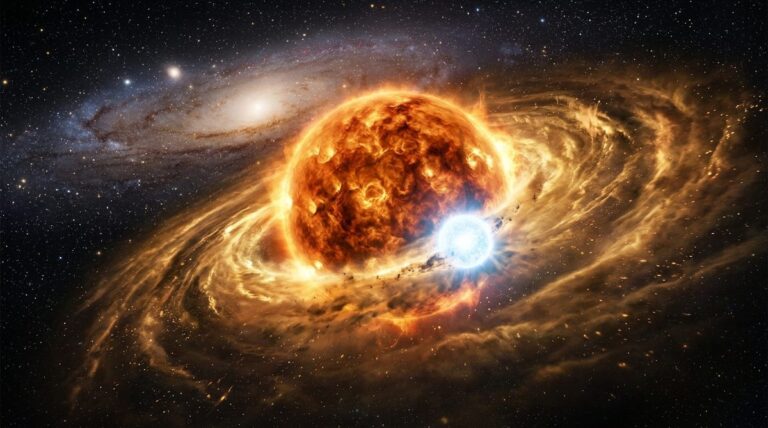
Most Distant Quasar Ever Found: Inside the 13-Billion-Year-Old Beacon “Dun Aonghasa”
Astronomers have just found the most distant quasar ever seen — a blazing galactic core shining at us from 13.1 billion years ago, when the universe was less than 5% of its current age. Announced on Tuesday, 24 November 2026, the discovery pushes the frontier of the observable universe back by nearly 40 million years in a single leap, the biggest jump in almost a decade.
The quasar, formally known as J1504+6252, has been nicknamed “Dun Aonghasa” after a prehistoric stone fort on the Aran Islands off Ireland’s west coast. It formed within just 630 million years of the Big Bang, yet the black hole powering it already weighed about 360 million times as much as our Sun. That single fact is now forcing scientists to rethink how the universe’s first giant black holes grew so fast.
What Is the Most Distant Quasar, and Why Does It Matter?
A quasar is the bright, compact core of a galaxy, powered by a supermassive black hole feeding on gas and dust. As matter spirals in, it heats up and glows so fiercely that a single quasar can outshine its entire host galaxy — which is why quasars can be spotted across billions of light-years.
The new record-holder is special for three reasons:
- It is the farthest quasar ever confirmed. At a redshift of 8.13, it is the first quasar ever identified beyond redshift 8, and it existed about 40 million years earlier than the previous record-holder.
- It is impossibly massive for its age. Just 630 million years after the Big Bang, its black hole had already reached roughly 360 million solar masses.
- It sets a new deadline for black hole growth. As study leader Julien Wolf of the European Southern Observatory put it, “Dun Aonghasa gives us a new deadline” for the early universe: whatever process built these giants had to work fast.
“This time the leap in cosmic time is huge!” Wolf said. “The previous two records each took us back by about 15 million years or less. This one takes us back by nearly 40 million years, the biggest advance in nearly a decade!”
How Euclid Found a Needle in Millions of Galaxies
The quasar was first spotted by the European Space Agency’s Euclid telescope, which launched in July 2023 to map a third of the sky and shed light on dark matter and dark energy. Wolf and his German-led team found the candidate while digging through about 18 months of data from the Euclid Wide Survey — sifting through millions of observed objects to pick out one tiny red dot, the quasar’s image in a patch of sky just 30 arcseconds across.
But a candidate is not a confirmation, so an extensive follow-up campaign swung into action:
- W. M. Keck Observatory in Hawaii and the Hubble Space Telescope provided the first hints that the object was a genuine high-redshift quasar.
- The Large Binocular Telescope Observatory in Arizona added further evidence.
- The James Webb Space Telescope (Webb) delivered the decisive measurement, revealing the redshift of 8.13 and the black hole’s mass.
The follow-up images showed luminous blue light, characteristic of the disks of gas spiraling into a supermassive black hole, and spectra with broad emission lines — gas clouds whipping around the black hole in tight orbits — a defining signature of quasars. Together, the observations pinned the quasar’s position on the cosmic timeline: 630 million years after the Big Bang.
Notably, Euclid had already broken the quasar distance record once before, only a few months earlier. Researchers say Euclid may yet spot quasars even farther away, with theoretical models suggesting the first quasars could date to 270 million to 470 million years after the Big Bang. “So in short: this is the furthest quasar we have ever seen, but maybe not the furthest there is to find,” Wolf said.
Why Is It Called “Dun Aonghasa”?
The nickname comes from Dun Aonghasa (Dún Aonghasa), a prehistoric stone fort perched on a cliff on Inis Mór, the largest of Ireland’s Aran Islands. The fort faces the vast expanse of the Atlantic Ocean — and Wolf, whose wife and daughter are Irish, was awestruck when they visited it. The European Space Agency drew the same parallel: just as the fort stands at the Atlantic edge where land gives way to a vast oceanic horizon, J1504+6252 stands at the current observational frontier of quasars. The formal designation, J1504+6252, comes from the object’s coordinates on the sky.
A Black Hole That Grew Too Fast — Then Slowed Down
The biggest puzzle is not that the black hole is big. It is that it is big so early. Black holes grow by pulling in gas, and there is a speed limit to that feeding — the Eddington limit — beyond which radiation from the infalling gas pushes further gas away. Building a 360-million-sun black hole in only 630 million years stretches that picture to its limits. Yet observations show Dun Aonghasa is currently feeding far below that limit, at only about 12% to 44% of its maximum rate, depending on the mass calibration used. That means it must have grown much faster earlier in its life, started out far heavier than expected, or both.
Scientists are weighing a few explanations:
- Direct collapse: A massive cloud of gas condensed under its own gravity and collapsed straight into a heavy black hole, skipping the slow build-up from a single dead star.
- Rapid early feeding: The black hole may have gorged on gas at or near its maximum rate in its first few hundred million years, then settled into the slower feeding we see today.
- A heavy seed: The black hole may have been born from an unusually massive “seed,” giving it a head start smaller seeds could never match.
The conditions for a direct collapse must have been rare in that era, which may explain why so few quasars have been found at redshifts beyond 7.5 so far. Each new one tightens the constraints on how the first giants formed — and Dun Aonghasa, the most extreme example yet, tightens them the most.
The Most Distant Quasar at a Glance
| Fact | Detail |
|---|---|
| Formal name | J1504+6252 |
| Nickname | Dun Aonghasa (Dún Aonghasa) |
| Redshift | 8.13 — the first quasar beyond redshift 8 |
| Age of the universe when seen | 630 million years after the Big Bang |
| Light travel time | About 13.1 billion years |
| Universe’s age at the time | Under 5% of its current age |
| Black hole mass | About 360 million Suns (range roughly 200–800 million) |
| Previous record beaten by | About 40 million years |
| Discovered by | ESA’s Euclid telescope |
| Confirmed by | Hubble, Webb, Keck, and the Large Binocular Telescope |
| Announced | 24 November 2026 |
| Published in | Astronomy & Astrophysics (DOI: 10.1051/0004-6361/202662243) |
Why This Discovery Matters for the Rest of Us
It is fair to ask what a faint red dot from 13.1 billion years ago has to do with life on Earth. The answer is that quasars are more than cosmic curiosities — they are the brightest beacons from the universe’s childhood, and they light up everything around them.
First, quasars help astronomers study the era when the first stars and galaxies switched on. Their light passes through the gas between galaxies on its way to us, carrying a fingerprint of what that gas was made of — and a quasar this distant reaches further back into that era than any before it. Second, the discovery tests our whole story of cosmic growth: if black holes could reach 360 million solar masses within 630 million years, the early universe was far more efficient at building giants than many models assumed.
And then there is the sheer wonder of the timescale. The light now reaching our telescopes left this quasar long before the Sun existed, before the Earth formed, before any life appeared. In a month when skywatchers are already looking up — for the December 2026 Cold Supermoon on December 23 and the Geminid meteor shower on December 13–14 — Dun Aonghasa is a reminder that the night sky also holds beacons from the dawn of time itself. Even Voyager 1, now a full light-day from Earth after 49 years of travel, has covered only a tiny fraction of the distance this quasar’s light has traveled to reach us. To feel the scale, imagine the universe’s 13.8-billion-year history as a single 24-hour day: Dun Aonghasa’s light left when the day was barely more than an hour old.
Frequently Asked Questions (FAQs)
What is the most distant quasar ever found?
The most distant quasar ever found is J1504+6252, nicknamed “Dun Aonghasa,” announced on 24 November 2026. At a redshift of 8.13, we see it as it was just 630 million years after the Big Bang, about 13.1 billion years ago — roughly 40 million years earlier than the previous record-holder.
How big is the black hole powering Dun Aonghasa?
About 360 million times as much as our Sun, according to Webb Space Telescope measurements. Different calibrations give a range of roughly 200 million to 800 million solar masses — but even the low end is an enormous mass for a black hole less than a billion years after the Big Bang.
Who discovered the most distant quasar?
A German-led team headed by astronomer Julien Wolf, a postdoctoral researcher at the Max Planck Institute for Astronomy in Heidelberg who is now at the European Southern Observatory, discovered it in data from ESA’s Euclid space telescope. Hubble, Webb, Keck, and the Large Binocular Telescope confirmed the find.
Why is the quasar nicknamed Dun Aonghasa?
Wolf named it after Dun Aonghasa, a prehistoric stone fort on a cliff on Inis Mór in Ireland’s Aran Islands. His wife and daughter are Irish, and he was awestruck when they visited the fort. Like the fort, which stands at the edge of the Atlantic, the quasar stands at the current frontier of what telescopes can observe.
Could an even more distant quasar be found?
Yes. Researchers say Euclid may spot quasars at even greater distances, and theoretical models suggest the first quasars could have formed just 270 million to 470 million years after the Big Bang. Dun Aonghasa is the farthest quasar seen so far, but probably not the farthest that exists.
Conclusion
The most distant quasar ever found is more than a new entry in the record books. Dun Aonghasa is a message from the universe’s first billion years, telling us that giant black holes were already thriving when the cosmos was still in its infancy — and challenging every theory of how they got there so fast. As Euclid keeps scanning the sky, this 13.1-billion-year-old beacon may soon be beaten. Until then, it stands at the edge of the known universe, lighting the way further back in time than we have ever seen.
Sources
- ESA — Euclid breaks own quasar record by 40 million years
- Reuters — Astronomers spot record-setting quasar in the early universe
- The Hindu Business Line — Scientists discover most distant quasar yet, dating back 630 million years after Big Bang
- Phys.org — New quasar record tightens constraints on black hole formation scenarios
- Sky & Telescope — Record-Breaking Black Hole Beacon Shines from the Early Universe
- Max Planck Institute for Astronomy — Euclid observes a supermassive black hole only 630 million years after the Big Bang
- Astronomy & Astrophysics — Euclid: Discovery of a quasar at z = 8.13 hosting a 360-million solar-mass black hole (DOI: 10.1051/0004-6361/202662243)