How a Giant Star Swallowed Another Star in Andromeda: Inside NASA’s First Real-Time Stellar Merger (“Bao”)
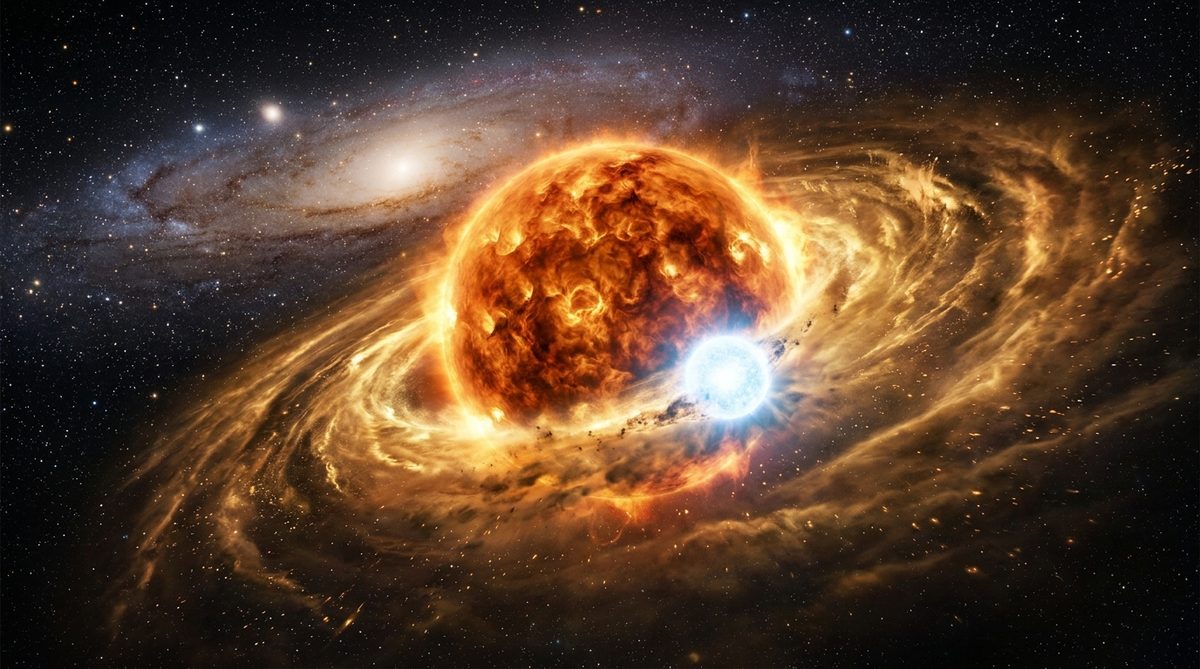
Quick answer : On November 18, 2026, NASA and Columbia University astronomers revealed the first real-time observation of a massive binary star merger—nicknamed "Bao" (AT 2025abao)—on the outskirts of the Andromeda galaxy. Captured by the James Webb Space Telescope just 47 days after peak brightness, a puffy supergiant 350 times wider than our Sun swallowed a smaller companion star in only seven orbits, unlocking a long-standing mystery about how black holes and neutron stars form.
Most stars in the universe do not live alone; they grow up in pairs, circling one another for millions of years. For decades, astrophysicists knew that when one star swells into a bloated giant, it can swallow its partner inside a shared cloud of gas—a dramatic phase called common envelope evolution. Yet until this week, nobody had ever watched the full spiral-in of a massive stellar merger unfold from start to finish.
Published in Nature on November 18, 2026, by a team led by NASA Hubble Fellow Viraj Karambelkar at Columbia University (NASA Science), the James Webb stellar merger Andromeda Bao discovery finally gives astronomers a front-row recording of a star eating its neighbor—pieced together from seven different space and ground telescopes.
350×
Radius of “Big Bao”
The primary supergiant was 7 times as massive as our Sun, 350 times wider (roughly spanning beyond Earth’s orbit), and 18,000 times brighter (NASA Science).
7 orbits
Lightning-fast inspiral
Once “Little Bao” (0.7 solar masses) grazed the giant’s outer layer, drag pulled it inward in only seven years—versus thousands of orbits for smaller mergers (NASA Science).
47 days
Fastest JWST follow-up
Webb observed AT 2025abao on December 24, 2025, under emergency Director’s Discretionary Time—the earliest stellar-merger portrait ever taken (NASA Science).
How Seven Telescopes Solved the Crime Scene (2018–2026)
Most early news blurbs jump straight to the eruption, skipping the detective chain that made Bao unique (NASA Science; ScienceDaily):
- 2018–February 2023 (NEOWISE): Archival data from NASA’s retired NEOWISE mission showed the star shining steadily before 2018, then flickering strangely by early 2023.
- September 2024 (WINTER): Infrared tracking revealed brightening and fresh plumes of ejected dust as orbital friction heated up.
- July 2025 (NASA SPHEREx): Visible light began fading behind a thickening shroud of dust while infrared heat climbed sharply.
- October 17, 2025 (Zwicky Transient Facility): ZTF caught the dramatic merger eruption, which peaked within a single week.
- November–December 2025 (Swift, Gemini North & JWST): Rapid follow-ups from the Neil Gehrels Swift Observatory, NOIRLab’s Gemini North in Hawaii, and Webb’s December 24 observation locked in the merger’s chemistry and geometry.
Why “Common Envelope Evolution” Matters for Black Holes
Imagine trying to run through waist-deep water: drag steals your forward momentum fast. When Little Bao plunged into Big Bao’s puffed-up atmosphere, friction stripped away its orbital energy in just seven loops, fusing the two stars into one. In other binary pairs where both stellar cores survive instead of merging completely, that same orbital drag pulls the two stars razor-close—setting the stage for future supernovae, millisecond pulsars, neutron-star collisions, and gravitational-wave black-hole mergers (NASA Science).
Even better, Bao is only the opening chapter: astronomers expect a wave of similar merger detections starting in late 2026 and 2027 via the Vera C. Rubin Observatory, JWST Cycle 5 MIRI spectroscopy, and NASA’s newly launched Nancy Grace Roman Space Telescope (CASRAI).
Common Questions About the Andromeda Stellar Merger :
What happened when a giant star swallowed another star in Andromeda?
A 7-solar-mass supergiant (“Big Bao”) engulfed a 0.7-solar-mass companion (“Little Bao”) over seven orbits, ejecting dusty gas and erupting into a bright transient designated AT 2025abao (NASA Science).
What is “common envelope evolution” in binary stars?
It is a brief, violent phase when one expanding star wraps its companion inside a shared outer gas shell, creating drag that shrinks the orbit dramatically and either merges the stars or leaves a tight binary remnant.
How did the James Webb Space Telescope capture the Bao merger?
Using urgent Director’s Discretionary Time, Webb aimed its infrared instruments at AT 2025abao on December 24, 2025—47 days after peak brightness—piercing the thick dust cocoon that hid the merger in visible light.
Could a star merger like Bao happen in the Milky Way or affect Earth?
Binary star mergers do occur across the Milky Way, and Roman’s Galactic Bulge survey expects to catch more of them—but our Sun is a single star with no companion, and Andromeda sits roughly 2.5 million light-years away, posing zero danger to Earth.