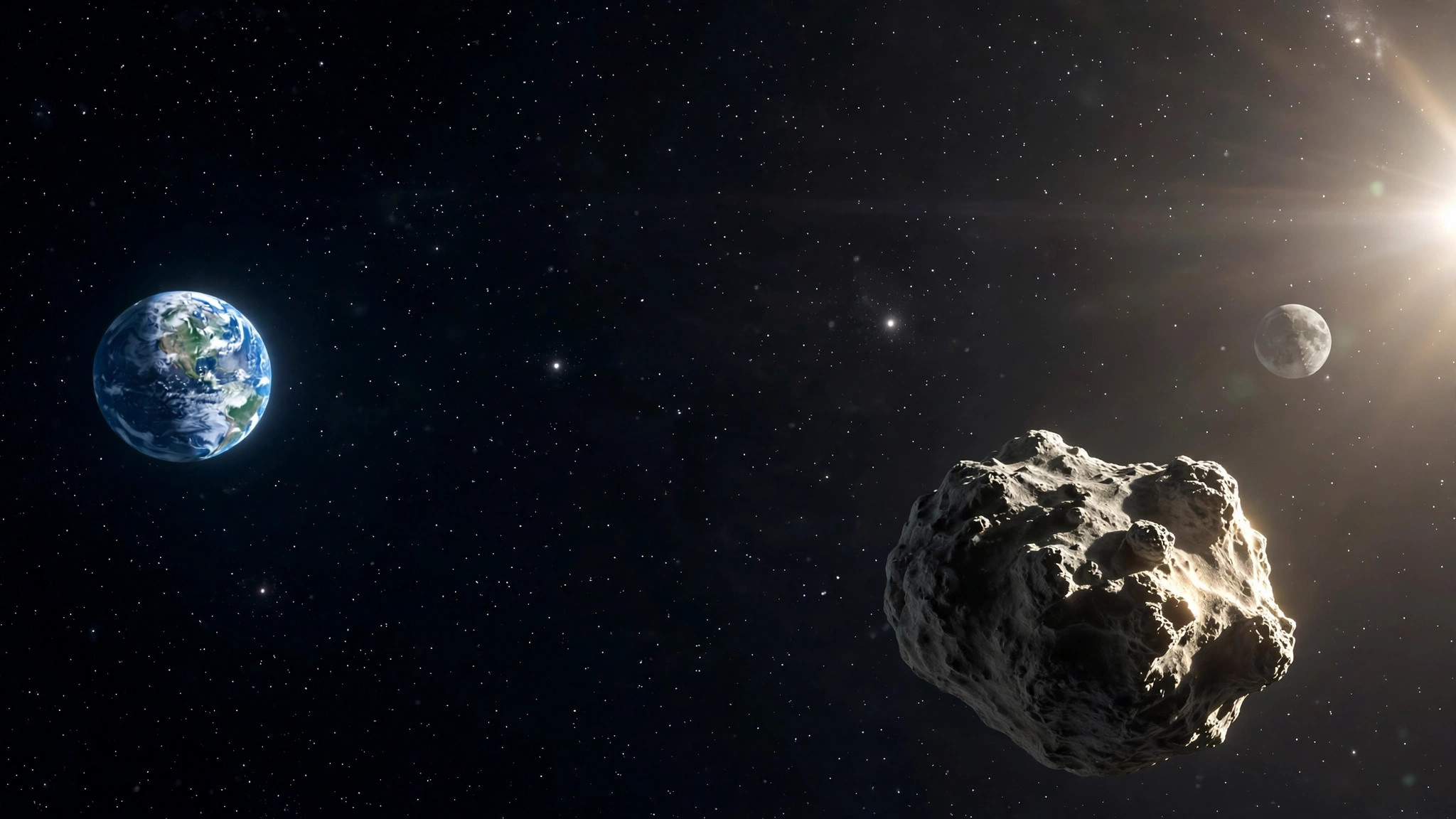
Earth Has a New Mini-Moon: What Is Asteroid 2026 QQ8 and How Long Will It Stay?
Earth has a temporary second moon — and it is barely bigger than a person. The asteroid 2026 QQ8, a space rock only about 1–2 metres (roughly 3–6 feet) across, was quietly captured by Earth’s gravity back in April 2026, and it will stay with us until December 2026 or January 2027 before drifting back into its own orbit around the Sun.
You cannot see it with the naked eye, and it poses no danger to our planet. But this tiny visitor is a big deal for astronomers: it is one of the rare “mini-moons” ever confirmed, and studying it helps scientists understand the thousands of small rocks that share Earth’s neighborhood.
What Is asteroid 2026 QQ8?
The asteroid 2026 QQ8 is a small natural space rock that is temporarily orbiting Earth. It is classified as an Aten asteroid — a type of asteroid whose orbit around the Sun regularly brings it close to Earth. In normal times, it takes about 359 days to complete one trip around the Sun, just a few days shorter than an Earth year, and it swings near our planet roughly once every ten years.
Here is what makes this one special:
- It is a “temporarily captured object.” Earth’s gravity caught it as it passed by, bending its path into a temporary orbit around our planet.
- It is tiny. Estimates put it at about 1–2 metres across — roughly the size of a person, or a large dog. Some reports say about 1 metre (3 feet), others about 2 metres (6 feet), and European Space Agency data suggests a range of 1.4–3 metres. The exact size is still uncertain because the rock is so small and faint.
- It is natural, not space junk. When it was first spotted, astronomers were not sure whether it was a real asteroid or a piece of an old rocket or satellite. Follow-up observations with the Lowell Discovery Telescope in Arizona and the University of Hawaii’s 2.2-metre telescope on Mauna Kea confirmed it is a natural space rock.
- It is not a second permanent moon. Our Moon has orbited Earth for billions of years. This visitor is only passing through.
How Earth Captured asteroid 2026 QQ8
The capture happened quietly, months before anyone noticed. Orbital calculations show that the asteroid 2026 QQ8 drifted into Earth’s gravitational sphere of influence in late April 2026. The discovery itself came later. Hungarian astronomer Krisztián Sárneczky, a research coordinator at the Konkoly Observatory in Hungary, first spotted the object on 19–20 August 2026 while searching for near-Earth asteroids. Its secret only emerged after weeks of precise tracking. Finally, on 29 October 2026, the International Astronomical Union’s Minor Planet Center announced the object as a natural mini-moon and gave it the designation 2026 QQ8.
As Minor Planet Center director Matthew Payne told CNN, mini-moons may be more common than we think: “At any given time, there is likely to be at least one mini-moon around Earth.” Most are simply too small and faint for us to notice.
How Big Is the Mini-Moon — and Why Do Sources Disagree?
Size is the one fact about this visitor that even the experts cannot pin down exactly, and the numbers you see depend on which source you read. Astronomers estimate its size from how bright it appears, combined with a guess about how reflective its surface is.
- About 1 metre (3 feet): EarthSky and The Times of India.
- About 2 metres (6 feet): CNN, Smithsonian Magazine and the New York Post.
- About 1.4–3 metres (4.6–9.8 feet): European Space Agency data cited by The Weather Channel.
The honest answer is that asteroid 2026 QQ8 is somewhere in the range of about 1–2 metres wide — small enough to fit in a living room, and far too faint for backyard telescopes. For comparison, our Moon is about 3,475 kilometres across.
How Long Will It Stay?
Most reports say the asteroid 2026 QQ8 will remain bound to Earth until early December 2026, while others put its departure in January 2027. Smithsonian Magazine splits the difference, saying December or January. What all sources agree on is the shape of the story: the capture lasts roughly eight to nine months, and the rock will then escape Earth’s gravity and return to its regular orbit around the Sun in 2027.
A few key dates in its visit:
- Late April 2026: Earth’s gravity captures the asteroid.
- 19–20 August 2026: Krisztián Sárneczky first spots it from Hungary.
- 29 October 2026: The Minor Planet Center officially designates it 2026 QQ8 and confirms it as a natural mini-moon.
- 13 December 2026: A predicted pass at about 840,000 miles from Earth, according to ESA calculations cited by The Weather Channel.
- December 2026 or January 2027: The mini-moon leaves Earth’s gravitational influence and continues its journey around the Sun.
The rock is expected to come near Earth again in 2058, but that approach is not expected to result in another capture.
Quick Guide: asteroid 2026 QQ8 at a Glance
| Fact | Detail |
|---|---|
| Name | 2026 QQ8 |
| What it is | Temporarily captured asteroid (“mini-moon”) |
| Size | About 1–2 metres (roughly 3–6 feet) |
| Captured by Earth | Late April 2026 |
| First spotted | 19–20 August 2026, by Krisztián Sárneczky |
| Officially announced | 29 October 2026, by the Minor Planet Center |
| Expected departure | December 2026 or January 2027 (sources differ) |
| Closest approach | About 568,000 km (353,000 miles) |
| Orbit around the Sun | About 359 days |
| Asteroid type | Aten asteroid |
| Visible to the naked eye? | No |
| Danger to Earth? | No |
asteroid 2026 QQ8 vs. 2024 PT5: How Mini-Moons Compare
- Size: 2024 PT5 was much bigger, at about 7–10 metres across, while 2026 QQ8 is only about 1–2 metres.
- Length of stay: 2024 PT5 stayed for just 56.6 days, from 29 September to 25 November 2024. The asteroid 2026 QQ8 is staying far longer, at roughly eight to nine months.
- Full orbit? 2024 PT5 never completed a full loop around Earth before leaving. Whether 2026 QQ8 completes a full orbit during its stay has not been confirmed.
- Origin: 2024 PT5’s reflected light matches lunar rock, and scientists believe it may be a piece of the Moon. The origin of 2026 QQ8 is still an open question.
- A dispute: Even 2024 PT5’s mini-moon status is debated. The astronomers who predicted its visit call it a mini-moon, but NASA’s planetary defense office says Earth’s gravity never fully captured it.
Other mini-moons stayed even longer. 2006 RH120 remained captured for about a year, from 2006 to 2007. 2020 CD3 holds the record, staying bound to Earth for more than two years before leaving in May 2020.
Could It Hit Earth?
No. There is no concern that the asteroid 2026 QQ8 could impact our planet, and it is not listed on the European Space Agency’s impact risk list. During its entire stay, its closest approach to Earth is about 568,000 kilometres (353,000 miles). Even if it entered our atmosphere, its tiny size means it would almost certainly burn up from friction before reaching the ground.
If you are planning a night of skywatching this December, you will have better luck with something you can actually see: our Geminid meteor shower 2026 guide explains how to catch the year’s best shooting stars. And the most distant quasar ever found shows how much stranger the universe gets the farther we look.
Why Mini-Moons Matter
Mini-moons are more than a curiosity. Every capture is a free science experiment: a small asteroid drifts into Earth’s neighborhood, lets telescopes study it up close, and then leaves on its own. These visits help astronomers test how gravity, sunlight and the Moon’s pull shape the paths of near-Earth objects. They also hint at how many small rocks are out there that we never see. New telescopes such as the Vera C. Rubin Observatory in Chile are expected to spot many more mini-moons in the years ahead. For now, the message is simple: look up, even if you cannot see it. Somewhere out there, far beyond the Moon, a rock the size of a person is quietly circling our planet — Earth’s smallest, briefest companion.
Frequently Asked Questions (FAQs)
What is asteroid 2026 QQ8?
Asteroid 2026 QQ8 is a small natural asteroid, about 1–2 metres across, that was temporarily captured by Earth’s gravity in April 2026. It is known as a “mini-moon” — a temporary second moon that will leave Earth’s influence in December 2026 or January 2027 and return to its own orbit around the Sun.
How long will asteroid 2026 QQ8 stay?
The mini-moon is expected to stay for roughly eight to nine months in total, from its capture in late April 2026 until it escapes Earth’s gravity. Sources disagree on the exact departure: some say early December 2026, others say January 2027. Either way, it will be gone early in 2027.
Can I see the mini-moon 2026 QQ8?
No. Asteroid 2026 QQ8 is far too small and faint to see with the naked eye, and even most amateur telescopes cannot pick it out. It is also far away — its closest approach is about 568,000 kilometres from Earth, roughly 1.5 times the distance to the Moon.
Who discovered asteroid 2026 QQ8?
Hungarian astronomer Krisztián Sárneczky first spotted it on 19–20 August 2026 while searching for near-Earth asteroids. The Minor Planet Center officially announced it as a natural mini-moon on 29 October 2026.
Is asteroid 2026 QQ8 dangerous?
No. It poses no threat to Earth. It is not on the European Space Agency’s impact risk list, it never comes closer than about 568,000 kilometres, and even if it entered the atmosphere, its tiny size means it would burn up harmlessly before reaching the ground.
Conclusion
The asteroid 2026 QQ8 is a reminder that Earth’s neighborhood is busier — and stranger — than it looks. A rock no bigger than a person wandered in from the asteroid belt, was caught by our planet’s gravity in April 2026, and will quietly slip away in December 2026 or January 2027, most likely never to be captured again. We cannot see it, and it cannot hurt us, but for a few months it gave Earth a second moon — and gave astronomers one more clue about the small, hidden rocks sharing our corner of the solar system.