Why Wide Toe Box Shoes Took Over Everyday Fashion in 2026—And How to Wear Them Without Foot Pain
Narrow, pointed footwear is losing its historic hold on street style and luxury fashion. In an unexpected aesthetic shift, wide toe box and foot-shaped silhouettes have migrated from niche wellness blogs directly onto major urban runways.
Luxury design houses such as Chanel and Balenciaga have integrated natural, foot-conforming profiles into their footwear lineups. Industry data reflects this shift: anatomical and barefoot-style footwear expanded into a $720 million global category, with projections pointing toward $1.1 billion by 2032 (Skeanie; 6Wresearch).
Key Takeaways
- Foot Strength Gains: Transitioning to minimal footwear can increase intrinsic foot muscle strength by up to 57.4% over six months of regular wear.
- Design Distinctions: A “wide toe box” shoe differs from a standard “wide-width” shoe by accommodating natural toe splay while maintaining a standard heel width.
- Cushioned Options: You do not need to wear paper-thin soles to protect your feet; cushioned anatomical sneakers offer wide toe boxes with protective underfoot padding.
- Transition Strategy: Abruptly switching from high-heeled or heavily structured shoes to zero-drop minimalist models can strain tendons; gradual adaptation is recommended.
Why Podiatrists Say Narrow Shoes Compromise Natural Balance
Podiatric specialists have long criticized traditional shoe design for prioritizing tapered shapes over natural human anatomy. When footwear forces toes into a wedge, it alters gait mechanics and compromises structural stability.
Dr. Alissa Kuizinas, a Boston-based board-certified podiatrist, highlights that persistent pressure on the big and pinky toes indicates an overly narrow toe box. Over time, chronic forefoot compression contributes to painful conditions, including bunions, hammertoes, corns, and plantar nerve irritation (NBC Selected).
Dr. Isaac Tabari, a podiatrist practicing in New York City, notes that providing adequate space for natural toe splay improves overall balance, weight distribution, and arch activation during movement (NBC Selected).
These biomechanical claims are supported by clinical research. A peer-reviewed 2021 study published in Scientific Reports found that participants who wore minimalist, foot-shaped shoes for daily activities increased their intrinsic foot muscle strength by an average of 57.4% over a six-month period (Skeanie).
Understanding Footwear Types: Wide Width vs. Wide Toe Box vs. Barefoot
Navigating anatomical footwear requires understanding key design distinctions that are often conflated in general shopping guides (NBC Selected; Anya’s Reviews).
| Category | Anatomical Design Profile | Ideal User Profile | Example Models |
|---|---|---|---|
| Standard “Wide Width” (EE/4E) | Scaled up proportionally across the heel, midfoot, and forefoot. | Individuals with overall wide volume feet from heel to toe. | Standard running shoes in “Wide” sizing options. |
| Cushioned Wide-Toe-Box | Standard heel and midfoot width combined with an anatomical, wide forefoot and protective cushioning. | People who stand on hard surfaces, work long shifts, or manage joint stiffness. | Birkenstock Bend Low, Brooks Ghost Max 3, Altra FWD Via, Lems Primal Zen. |
| True Barefoot / Minimalist | Foot-shaped toe box combined with a thin, highly flexible, zero-drop sole (no heel rise). | Individuals looking to maximize foot muscle activation and ground sensation. | Whitin Barefoot, Xero Shoes Dillon, Vivobarefoot Primus. |
Who Should Opt for Cushioned Wide Toe Boxes Over Minimalist Shoes?
While ultra-thin minimalist shoes offer functional benefits, they are not universally suitable for every individual or environment.
Individuals managing acute lower-limb conditions—such as active plantar fasciitis, Achilles tendinitis, stress fractures, or severe metatarsalgia—often require protective cushioning to manage impact forces (Anya’s Reviews).
Similarly, individuals with structural joint stiffness (such as hallux rigidus), severe fat pad atrophy, advanced diabetic neuropathy, or those who stand for long hours on concrete floors benefit significantly from cushioned wide-toe-box shoes. These models provide forefoot room without subjecting the foot bed to unyielding impact.
How to Select and Style Anatomical Footwear
Integrating foot-shaped shoes into a modern wardrobe involves evaluating both fit mechanics and visual styling.
1. Perform the Visual Trace Test
Remove the stock insole from the shoe and place your bare foot directly on top of it. If any of your toes overhang the edges of the insole, the toe box will compress your foot during locomotion (NBC Selected).
2. Style Around Balanced Visual Proportions
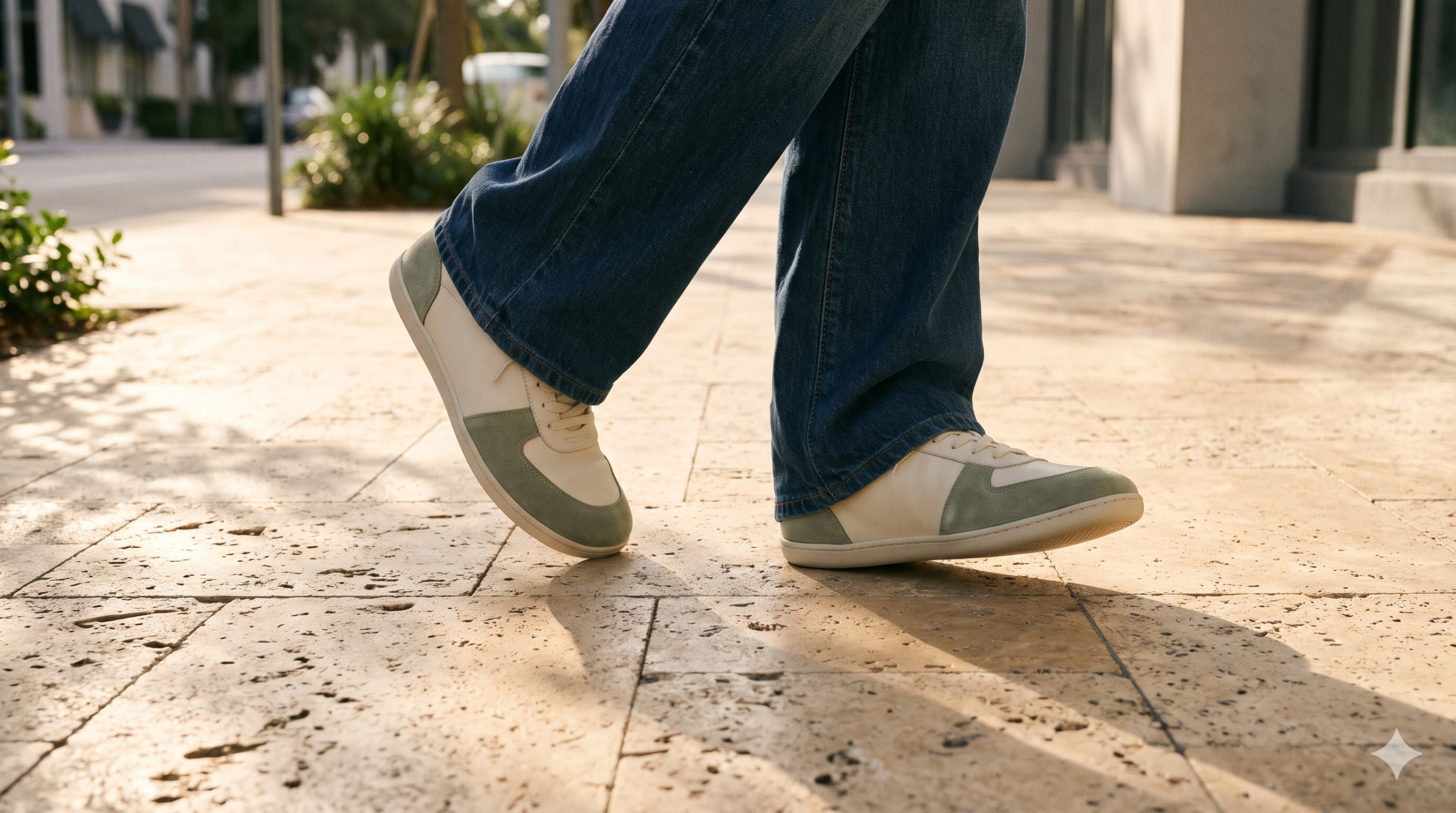
Pair rounded, wide-forefoot sneakers in neutral tones (such as off-white, olive, taupe, or black leather) with relaxed-fit trousers, wide-leg denim, or unstructured athleisure. Broader trouser openings balance the natural shape of the shoe, creating a clean silhouette.
3. Implement a Progressive Adaptation Schedule
If transitioning from traditional raised-heel footwear to zero-drop minimalist shoes, introduce them gradually. Begin by wearing them for 30 to 60 minutes of daily walking, slowly increasing duration over several weeks to allow calf muscles and connective tissues to adjust safely.
Frequently Asked Questions :
Are wide toe box shoes only meant for people with wide feet?
No. Standard wide-toe-box shoes feature a conventional heel and midfoot fit paired with a wider forefoot. This design prevents toe pinching for individuals with average or narrow heels who still require room for natural toe splay.
Are wide toe box shoes suitable for weightlifting and travel?
Yes. Podiatrists frequently recommend wide toe box designs for strength training, as spreading the toes enhances foundational stability during squats and deadlifts. They are also well-suited for long travel days involving extended walking.
What is the safest way to try the trend on a budget?
Starting with an accessible, cushioned wide-toe-box sneaker allows you to experience the benefits of natural forefoot splay without forcing your feet to adapt immediately to unpadded, zero-drop soles.