The History of Black Friday: How It Became America’s Biggest Shopping Day
Every November, Americans hear the same tidy explanation for Black Friday: it is supposedly the day retailers finally swing their annual ledgers out of losses (“in the red”) and into profit (“in the black”). It makes a great soundbite—and it is completely wrong. The true history of Black Friday is far more chaotic, stretching from a notorious 1869 Wall Street gold crash to frustrated 1950s Philadelphia police officers dreading post-Thanksgiving traffic jams.
Over the past century, that grim nickname evolved into a trillion-dollar cultural phenomenon that reshaped how Americans shop, celebrate Thanksgiving, and browse online. Here is how Black Friday actually started, which viral myths historians have debunked, and how the day transformed into today’s month-long digital shopping season.
In This Article
- Where Did the Term “Black Friday” Originate?
- Two Common Black Friday Myths—Debunked
- How American Retailers and Congress Built the Holiday Shopping Calendar
- How Black Friday Evolved Across the Decades
- The Rise of Online Shopping and Cyber Monday
- Black Friday in Modern America (2024–2026)
- Chronological Timeline of Black Friday
- Frequently Asked Questions
Where Did the Term “Black Friday” Originate?
In English, pairing “black” with a day of the week to signify disaster dates back to the 1570s, and “Black Friday” first appeared in print in 1610 (Snopes). In the United States, the phrase picked up three distinct meanings before becoming synonymous with holiday bargains.
1. The 1869 Wall Street Gold Crash
The first famous American “Black Friday” had nothing to do with Thanksgiving or department stores. On September 24, 1869, Wall Street speculators Jay Gould and James (“Jubilee” Jim) Fisk tried to corner the New York gold market by using political connections—including President Ulysses S. Grant’s brother-in-law—to keep the U.S. Treasury from selling gold (Britannica Money; Federal Reserve Bank of New York). When Grant caught wind of the scheme and ordered Treasury Secretary George Boutwell to release $4 million in government gold, prices plunged from $160 to $133, the stock market dropped 20%, and brokerage houses collapsed (Federal Reserve Bank of New York).
2. Workers Calling in Sick (1951)
Etymology researcher Bonnie Taylor-Blake traced the earliest known use of “Black Friday” for the day after Thanksgiving to the November 1951 issue of the industrial trade journal Factory Management and Maintenance (Visual Thesaurus). The article used the term to describe “Friday-after-Thanksgiving-itis”—factory workers calling in sick to stretch the holiday into a four-day weekend.
3. Philadelphia Police and the Failed “Big Friday” Rebrand (1950s–1960s)
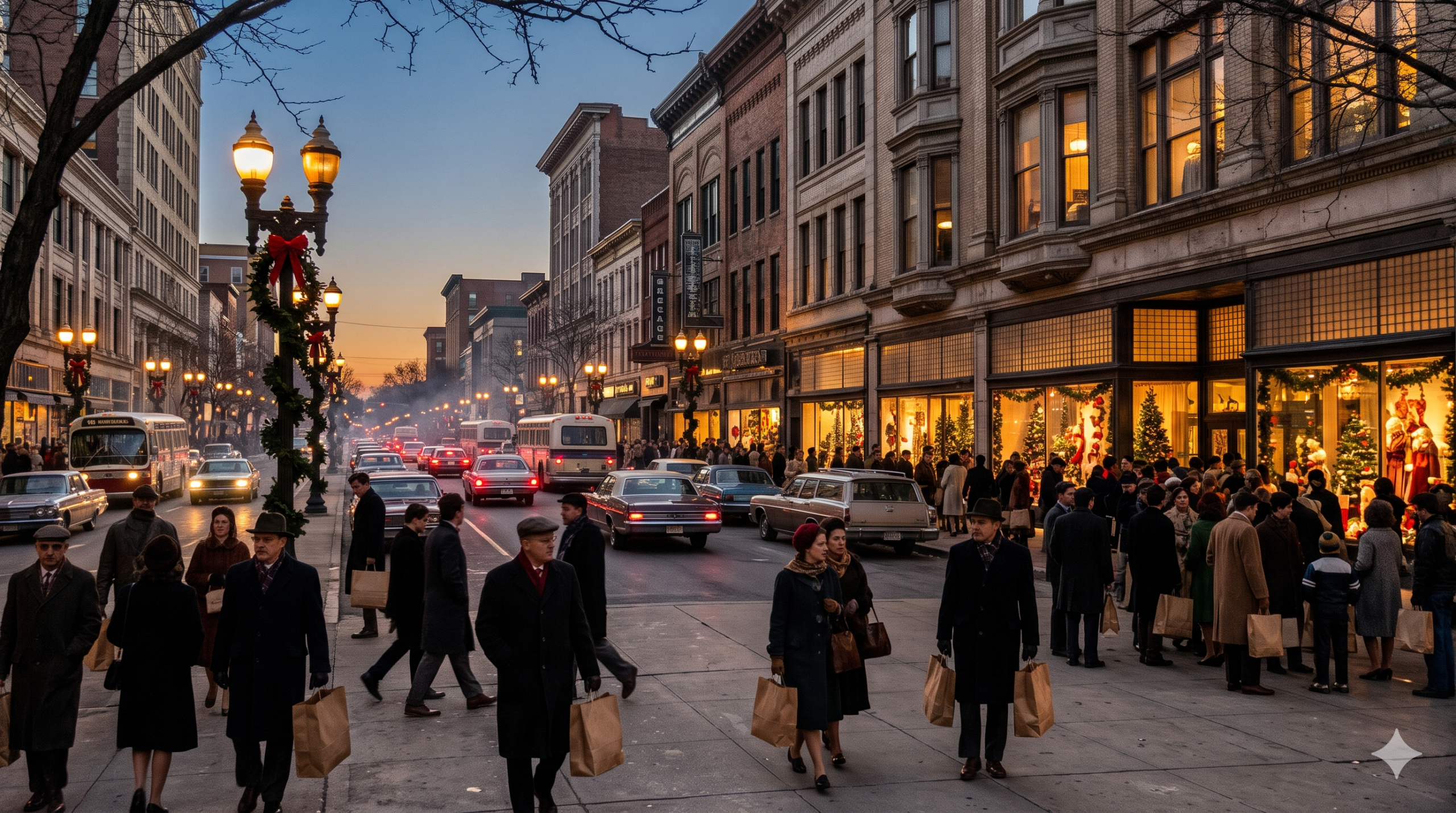
The retail meaning was born in Philadelphia. Throughout the 1950s and 1960s, city police officers, bus drivers, and cabbies dreaded the Friday after Thanksgiving because suburban shoppers flooded downtown streets right as crowds arrived for Saturday’s annual Army-Navy football game (Britannica; AP News). Officers worked mandatory 12-hour shifts battling gridlock and shoplifters, dubbing the chaos “Black Friday.”
Downtown merchants hated the negative connotation. A December 18, 1961 Public Relations News report documented their push with Philadelphia officials to rebrand the weekend as “Big Friday” and “Big Saturday”—an effort that flopped completely when local reporters refused to drop the catchier original name (Visual Thesaurus).
Two Common Black Friday Myths—Debunked
- The “Red to Black” Accounting Myth: Retailers did not coin Black Friday to celebrate turning an annual profit. According to etymology records, the “in the red to in the black” story only emerged in the 1980s (earliest print reference: 1981) as a clever public-relations spin to scrub away Philadelphia’s negative traffic reputation (Britannica; Snopes).
- The Viral Slavery-Auction Myth: Recurring social media posts since 2013 have falsely claimed Black Friday originated from discounted post-Thanksgiving auctions of enslaved people. Historians and fact-checkers have thoroughly debunked this claim: there is zero historical documentation for it, Thanksgiving only became a national U.S. holiday in October 1863 (months after the Emancipation Proclamation), and the phrase was not linked to post-Thanksgiving shopping until the mid-20th century (AP News; Snopes).
How American Retailers and Congress Built the Holiday Shopping Calendar
Even before the name existed, American retailers worked hard to turn the day after Thanksgiving into the official starting gun for Christmas shopping. On November 27, 1924, R.H. Macy & Company staged the first “Macy’s Christmas Parade” in New York City, unveiling holiday display windows to mark the expansion of its Herald Square flagship (Britannica; Smithsonian Magazine). For decades, an unwritten industry code held that stores waited until after Thanksgiving to launch Christmas ads (Britannica).
That unwritten rule triggered a presidential controversy in 1939. Because November had five Thursdays that year, a November 30 Thanksgiving threatened to squeeze Depression-era holiday sales. After retail lobbying, President Franklin D. Roosevelt issued Proclamation 2373 moving Thanksgiving one week earlier—a move critics mocked as “Franksgiving” that split the country between 32 states following FDR and 16 keeping the old date (National Archives; National Archives Press Release). Congress settled the dispute in December 1941 with House Joint Resolution 41, permanently fixing Thanksgiving to the fourth Thursday of November (National Archives).
How Black Friday Evolved Across the Decades
- 1980s — Nationwide Adoption: As suburban malls boomed, national retailers adopted both the “Black Friday” label and the upbeat “back in the black” story (Britannica).
- 1990s–2000s — Doorbusters and Overtaking “Super Saturday”: Stores introduced limited-quantity “doorbuster” electronics and pushed opening hours to 5 a.m. and midnight (Quartz). Surprisingly, International Council of Shopping Centers data shows Black Friday ranked only #4 to #8 among the busiest shopping days from 1993 to 2002, trailing the last Saturday before Christmas; it finally took the #1 spot in the early-to-mid 2000s (Snopes; TIME).
- 2010s — “Thanksgiving Creep” and Pushback: Chains began opening on Thanksgiving evening, sparking worker backlash and counter-campaigns like REI’s
#OptOutsideclosure starting in 2015, alongside Small Business Saturday (2010) and Giving Tuesday (2012) (Quartz). - 2020s — Permanent Closures and Month-Long Deals: The 2020 pandemic prompted Walmart, Target, and major chains to close on Thanksgiving Day permanently while stretching deals across November—and even into October (Britannica; Adobe Newsroom).
The Rise of Online Shopping and Cyber Monday
On November 28, 2005, Ellen Davis of the National Retail Federation (NRF) and its digital arm Shop.org coined “Cyber Monday” after spotting an online sales surge when shoppers returned from Thanksgiving weekend to faster broadband connections at their office desks (Wikipedia; Forbes).
U.S. Cyber Monday online spending exploded from $484 million in 2005 to a record $14.25 billion in 2025 (Hivenet; Adobe Newsroom, Dec. 2025). Today, Cyber Monday remains America’s single largest online spending day, while Black Friday draws more total shoppers across physical stores and e-commerce combined (NRF, Dec. 2025).
Black Friday in Modern America (2024–2026)
Modern Black Friday is an omnichannel, mobile-first event. Smartphones accounted for 56.4% of 2025 holiday online sales, Buy Now, Pay Later reached $20.0 billion for the 2025 season, and 59% of 2026 Thanksgiving weekend shoppers plan to use AI tools for product research and price checks (Adobe, Jan. 2026; NRF, Nov. 2026).
| Holiday Shopping Metric | 2024 (Verified) | 2025 (Verified) | 2026 (Forecast) |
| 5-Day Weekend Shoppers (NRF) | 197.0 million (NRF) | Record 202.9 million (NRF) | 182.7 million (NRF) |
| Black Friday Online Spend (Adobe) | $10.8 billion (Adobe) | $11.8 billion (Adobe) | $12.9 billion (Adobe) |
| Cyber Monday Online Spend (Adobe) | $13.3 billion (Adobe) | $14.25 billion (Adobe) | $15.1 billion (Adobe) |
| Full Nov–Dec Online Spend (Adobe) | $241.4 billion (Adobe) | $257.8 billion (Adobe) | $275.1 billion (Adobe) |
Chronological Timeline of Black Friday
| Year | Key Historical Milestone |
| 1869 | Jay Gould and Jim Fisk’s failed gold-market corner triggers Wall Street’s “Black Friday” crash on September 24 (Britannica Money). |
| 1924 | Macy’s stages its first Thanksgiving Christmas Parade in New York City (Britannica). |
| 1939 | President Roosevelt moves Thanksgiving a week earlier (“Franksgiving”) to lengthen holiday shopping (National Archives). |
| 1941 | Congress fixes federal Thanksgiving permanently to the fourth Thursday of November (National Archives). |
| 1951 | Factory Management and Maintenance prints the earliest known post-Thanksgiving “Black Friday” reference (Visual Thesaurus). |
| 1961 | Philadelphia merchants fail to rebrand police officers’ “Black Friday” as “Big Friday” (Visual Thesaurus). |
| 1980s | “Black Friday” spreads nationwide alongside the newly coined “red to black” accounting spin (Britannica). |
| Early 2000s | Black Friday overtakes the Saturday before Christmas as America’s busiest shopping day (TIME). |
| 2005 | NRF’s Ellen Davis coins “Cyber Monday” on November 28 (Wikipedia). |
| 2015 | REI launches #OptOutside, pushing back against Thanksgiving-evening openings (Quartz). |
| 2020 | Major chains permanently close on Thanksgiving Day as shopping shifts online and across November (Britannica). |
| 2025–2026 | Record 202.9M shoppers in 2025; NRF forecasts $1.013 trillion in total Nov–Dec 2026 U.S. retail sales (NRF). |
Frequently Asked Questions
1. Why is it called Black Friday?
The shopping-era nickname started with 1950s–1960s Philadelphia police and transit workers who dreaded the traffic jams, shoplifting, and 12-hour shifts caused by post-Thanksgiving shoppers and Army-Navy football crowds.
2. Is the “in the red to in the black” story true?
No. Historians and etymologists have shown that the accounting explanation was invented in the 1980s as a retail public-relations rebrand decades after the phrase was already used in Philadelphia.
3. When did Black Friday actually become America’s biggest shopping day?
Although retailers hyped the day in the 1980s and 1990s, Black Friday did not surpass the Saturday before Christmas (“Super Saturday”) as the year’s busiest shopping day until the early 2000s.
4. Who invented Cyber Monday?
Ellen Davis of the National Retail Federation and Shop.org coined “Cyber Monday” in a November 28, 2005 press release after tracking post-Thanksgiving online shopping spikes from office computers.
5. Do people spend more on Black Friday or Cyber Monday?
Online, Cyber Monday still holds the top spot ($14.25 billion vs. $11.8 billion in 2025 per Adobe Analytics), while Black Friday attracts more total shoppers when combining in-store and online traffic.
Conclusion
The real history of Black Friday is a classic American story of reinvention. What began as a Wall Street disaster and a Philadelphia police complaint was reshaped by parades, an act of Congress, suburban malls, and smartphones into the centerpiece of a trillion-dollar retail season. Next time you scroll through November deals from your couch, you are taking part in a tradition nearly a century in the making.
SOURCES & FURTHER READING
- Encyclopaedia Britannica – Black Friday (Retail)
- Encyclopaedia Britannica – Why Is It Called Black Friday?
- Encyclopaedia Britannica Money – Black Friday (1869)
- Federal Reserve Bank of New York – The Gold Panic of 1869
- Visual Thesaurus – The Origins of “Black Friday” (Bonnie Taylor-Blake Research)
- U.S. National Archives – Congress Establishes Thanksgiving
- Smithsonian Magazine – Macy’s Thanksgiving Day Parade Origins
- AP News – Fact Check: Origin of Black Friday
- Snopes – How Did “Black Friday” Get Its Name?
- National Retail Federation – 2025 Thanksgiving Weekend Record 202.9 Million Shoppers
- National Retail Federation – 2026 Thanksgiving Weekend Forecast
- Adobe Newsroom – 2025 Holiday Shopping Season Recap
- Adobe Newsroom – 2026 U.S. Holiday Shopping Forecast