
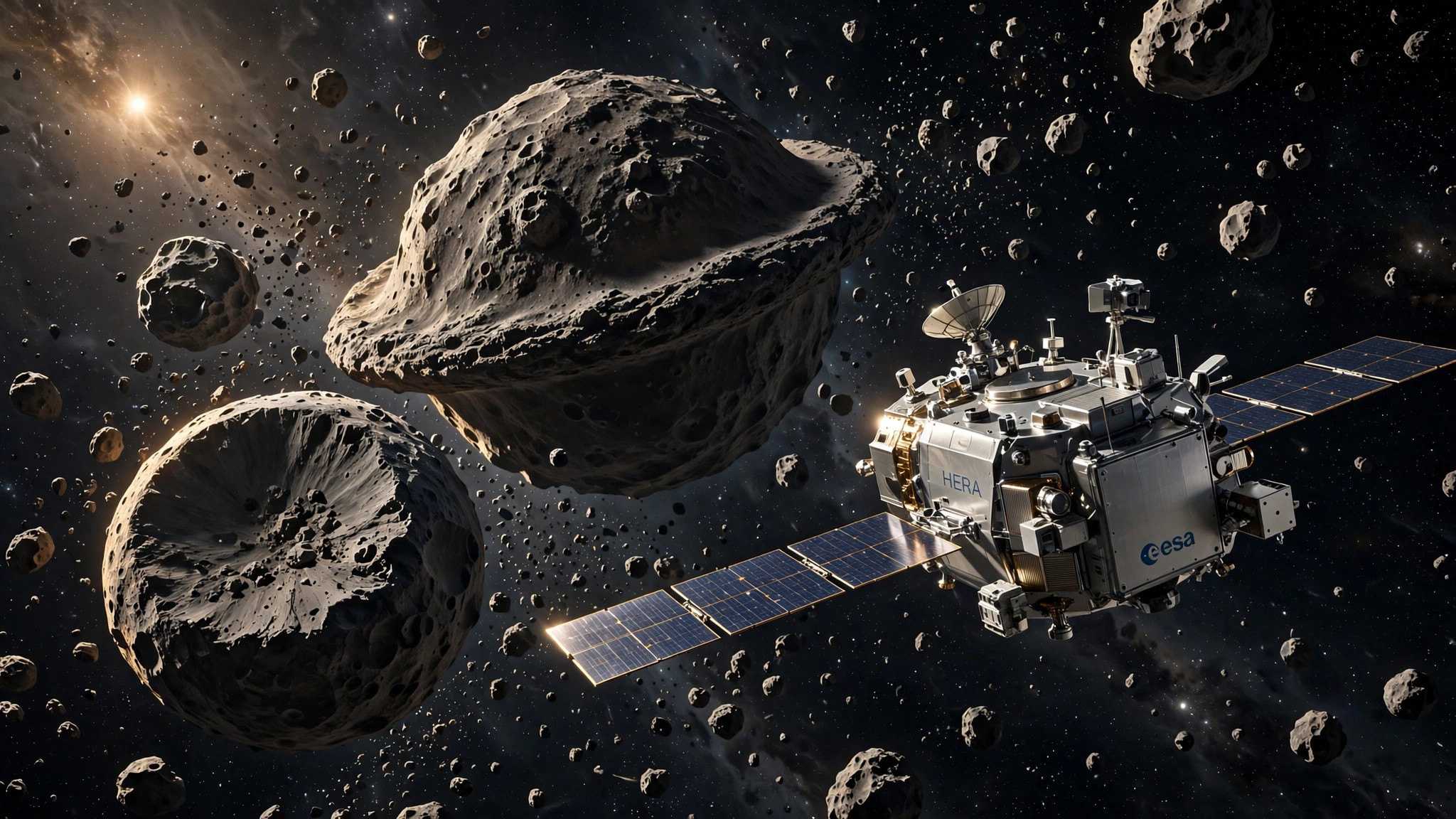
Hera Mission Reveals Stadium-Size Crater on Dimorphos After NASA’s DART Impact
Four years ago, NASA deliberately crashed a spacecraft into an asteroid to see whether humanity could deflect a dangerous space rock. Now the Hera mission Dimorphos images are in — and the damage is far more dramatic than anyone expected. The European Space Agency’s Hera spacecraft arrived at the asteroid pair in late October to early November 2026. It has revealed a stadium-size crater that flattened one whole face of the asteroid Dimorphos. In addition, the impact sent it tumbling chaotically and left hundreds of boulders flying around the system.
The first images, released on 25 November 2026, are the closest look ever at the aftermath of humanity’s first planetary defence test. They answer a question scientists have debated since 2022: did the impact leave a crater, change the asteroid’s shape, or do nothing much at all? As Hera principal investigator Patrick Michel put it, the answer turns out to be all three at once.
What Happened in 2022: NASA’s DART Impact
On 26 September 2022, NASA’s DART spacecraft — short for Double Asteroid Redirection Test — slammed into Dimorphos at about 13,645 miles per hour. (The German Aerospace Center gives a slightly higher figure, over 22,500 kilometres per hour, or about 13,980 mph; the difference is small and unexplained.) It was the first time humans had ever tried to change the motion of a celestial body on purpose.
The target was chosen carefully:
- Dimorphos is 151 metres (495 feet) wide — about the size of a football stadium, and comparable to asteroids that could genuinely threaten Earth.
- It orbits a larger asteroid, Didymos, which is about 730 metres across, at a distance of roughly one kilometre. Together they form a binary asteroid system.
- Neither asteroid poses any danger to Earth. That made the pair a perfect, safe testing ground.
- The impact worked. Telescopes on Earth measured that the impact shortened Dimorphos’s orbit around Didymos by 33 minutes. That was much more than scientists had predicted.
But what the impact actually did to Dimorphos itself — its shape, its surface, its spin — remained a mystery until Hera arrived. DART’s own camera went dark on impact, and Earth-based telescopes could only measure the orbit, not the damage.
What the Hera mission Dimorphos Images Show
Hera, a car-sized spacecraft launched in October 2024, spent just over two years travelling to the asteroid pair. The pair is currently 193.5 million kilometres (120.3 million miles) from Earth. Its first images, taken on 3 and 7 November 2026 from about 30 kilometres away, show three big surprises.
1. A crater as wide as the asteroid itself. Where DART’s camera showed a rounded face in 2022, Hera now sees a huge crater that has flattened that whole side of Dimorphos. “It’s a big crater that is almost as large as the body itself, which is really spectacular,” said Sabina Raducan, a planetary scientist at the International Space Science Institute in Bern and part of the Hera team. Inside the crater, Hera’s camera picked out striking structures, including an elongated, almost cigar-shaped feature at its centre. Scientists have not published an exact crater diameter in metres yet. For now, “stadium-sized” is the official description.
Hera mission Dimorphos Is Tumbling, and Boulders Are Flying
2. Dimorphos is tumbling out of control. Before the impact, Dimorphos always showed the same face to Didymos. Our Moon does the same thing for Earth. Now its rotation is chaotic. “Now [the rotation] is very chaotic — we call it ‘tumbling,'” Raducan explained, adding that it moves like “a barrel that you throw down the stairs.” Because of the tumble, Hera’s team cannot yet predict which face of Dimorphos will be pointing at the camera when it takes a photo.
3. Hundreds of boulders are flying around the system. The biggest surprise of all came next. Hundreds of previously unknown boulders orbit the asteroid pair, including more than 100 between the size of a football and a washing machine. “As we approached Didymos and Dimorphos, we quickly realized the asteroids were not alone,” said Naomi Murdoch, a planetary scientist at the University of Toulouse. “In fact, they had a lot of company.”
Meanwhile, Didymos itself looks almost untouched. Its boulder fields and its pronounced central ridge, running along its equator, look just as they did in DART’s 2022 images. The rest of Dimorphos, away from the crater, is similarly unchanged.
The Mystery of the Flying Boulders
The boulders are the puzzle Hera’s scientists most want to solve — and right now, they honestly do not know where they came from.
- Theory 1: DART debris. The 2022 impact could have blasted the boulders off Dimorphos, and they could still be circling the system four years later.
- Theory 2: material from Didymos. The larger asteroid Didymos could have shed them at some other time, for reasons unrelated to DART.
- Why it matters: the answer changes how scientists model asteroid impacts. If a deflection attempt litters the area with flying rocks, future missions need to plan for that.
“We cannot say today, with the information that we have, whether these were debris coming from the DART impact or whether there’s another origin, for example, coming off the primary asteroid,” Murdoch said. The team needs more time and more data to decide.
The boulders are also a practical headache. Hera carries two shoebox-sized CubeSats, Milani and Juventas. They are due to be released in January 2027 to fly close to Dimorphos and eventually land on it. The boulders present a collision risk. Margherita Cardi, the engineer who oversees Milani, called their discovery three weeks before the reveal a “nightmare” challenge for her team — but also said the team can engineer its way through it: “We can take these challenges and understand what engineering approach we can depict and create in order to survive.”
Quick Guide: Hera mission Dimorphos at a Glance
| Fact | Detail |
|---|---|
| Mission | ESA’s Hera — first planetary defence mission, first to explore a binary asteroid |
| Launched | October 2024 |
| Arrived at Didymos/Dimorphos | Late October to early November 2026 (sources differ slightly) |
| First images released | 25 November 2026 |
| Target | Dimorphos, 151 m (495 ft) wide, orbiting Didymos (730 m wide) |
| DART impact | 26 September 2022, about 13,645 mph |
| Orbital change from DART | Dimorphos’s orbit shortened by 33 minutes |
| Crater | Stadium-size, spans the entire impacted face; exact diameter not yet published |
| Dimorphos’s spin now | Chaotic tumbling — no longer tidally locked |
| Orbiting boulders | Hundreds, including 100+ football- to washing-machine-size; origin unknown |
| Hera’s current distance | About 25–30 km, moving at just 12 cm per second |
| Distance from Earth | 193.5 million km (120.3 million miles) |
| Next steps | Closer approach to ~13 km in December 2026; CubeSats released January 2027 |
| Mission continues until | June 2027 |
What Happens Next for the Hera mission Dimorphos
These first images are only the beginning. Hera is now in its early characterisation phase, observing with three instruments. They are the monochrome Asteroid Framing Camera, the HyperScout-H multispectral camera that sees in 25 colours at once, and JAXA’s Thermal Infrared Imager, which measures surface temperatures.
The schedule ahead:
- December 2026: Hera approaches to around 13 kilometres (8 miles) from the asteroid pair. It will take higher-resolution images and make the critical observations needed to calculate Dimorphos’s mass. “With the Hera measurements of the mass, we will then be able to see exactly how effective and efficient the DART impact was,” Murdoch said.
- January 2027: The team releases the two CubeSats, Milani and Juventas, to venture closer to Dimorphos and eventually land on it — if the boulder hazard allows.
- Through June 2027: Hera keeps studying the system, getting closer and closer, eventually imaging the asteroids in detail down to a few centimetres.
The mass measurement is the key number. Knowing exactly how heavy Dimorphos is, combined with the crater’s size and the 33-minute orbital change, will tell scientists precisely how efficient the DART impact was. It will also let them improve the computer models that predict how other asteroids would respond to a deflection attempt. That is the whole point of the mission: if an asteroid is ever found heading for Earth, humanity needs to know that a spacecraft impact will actually work.
Why This Matters: Learning to Defend Earth
The stakes were on display at the press briefing itself. ESA unveiled Hera’s first images in the dinosaur hall of the Museum für Naturkunde Berlin — a deliberate choice. Sixty-six million years ago, a city-size asteroid hit Earth and wiped out the dinosaurs. “Sixty-six million years ago, an asteroid impact changed the course of life on Earth,” Hera mission manager Ian Carnelli said. “Today, for the first time in history, humanity is validating how to prevent such an event from happening again.”
It is the same reason scientists study every small rock that comes near us. That includes the tiny temporary mini-moon asteroid 2026 QQ8, which Earth captured earlier this year. Each visitor teaches us something about the thousands of near-Earth objects sharing our corner of space. And if you want to look up yourself this December, our Geminid meteor shower 2026 guide shows how to catch the year’s best shooting stars, even from a city.
Hera’s message so far is encouraging and humbling at once. We can move an asteroid, but the impact does more than we predicted. For example, it reshapes the rock, scrambles its spin, and litters its neighbourhood with debris. Planetary defence is real, but it is messier than the movies. Hera will spend the next seven months finding out exactly how messy — and exactly how well it works.
Frequently Asked Questions (FAQs)
What did the Hera mission Dimorphos images reveal?
The Hera mission Dimorphos images, released on 25 November 2026, revealed a stadium-size crater that flattened one whole face of the asteroid Dimorphos. They also revealed chaotic tumbling of the asteroid’s spin and hundreds of previously unknown boulders orbiting the Didymos-Dimorphos system. The crater spans almost the entire width of the impacted face, and inside it Hera’s camera spotted a cigar-shaped structure at its centre.
What is the Hera mission?
Hera is the European Space Agency’s first planetary defence mission. Launched in October 2024, it travelled for just over two years to the binary asteroid system Didymos and Dimorphos. It went there to study the aftermath of NASA’s 2022 DART impact, the first time humans deliberately changed the motion of a celestial body. Hera will study the asteroids until June 2027, measuring Dimorphos’s mass and mapping the damage in detail.
How big is the crater on Dimorphos?
ESA describes the crater only as “stadium-sized” and says it extends across the asteroid’s entire impacted face, which is about 151 metres (495 feet) wide. Scientists have not published an exact crater diameter in metres yet. Hera’s closer approaches in December 2026 should allow a more precise measurement.
Is Dimorphos tumbling after the DART impact?
Yes. Before the impact, Dimorphos always showed the same face to Didymos, like our Moon does to Earth. The DART impact knocked it into a chaotic tumble, so its rotation is no longer predictable. As a result, Hera’s team cannot yet say which face will be pointing at the camera when it takes a photo. Scientists describe it as moving like “a barrel that you throw down the stairs.”
Where did the boulders around Dimorphos come from?
Nobody knows yet. The hundreds of boulders orbiting the Didymos-Dimorphos system include more than 100 between the size of a football and a washing machine. They could be debris from the DART impact in 2022, or material shed from the larger asteroid Didymos. The Hera team says it needs more time and data to decide. In addition, the boulders pose a collision risk for the mission’s two CubeSats, due to be released in January 2027.
Could an asteroid like Dimorphos hit Earth?
Dimorphos and Didymos themselves pose no danger to Earth. But asteroids of Dimorphos’s size — about 151 metres across — could threaten our planet, which is exactly why NASA and ESA chose this pair as a test target. The DART-Hera experiment aims to prove that a spacecraft impact can deflect such an asteroid if one is ever found on a collision course.
Conclusion
The Hera mission Dimorphos results show that humanity’s first asteroid deflection did far more than nudge an orbit. It carved a stadium-size crater across an entire face of Dimorphos, knocked the little asteroid into a chaotic tumble, and scattered hundreds of boulders around the system. Over the next seven months, Hera will measure Dimorphos’s mass, map the crater in centimetre detail, and send its CubeSats in close. That work will turn a spectacular crash into the hard numbers that could one day save a city, or a planet.
Sources
- ESA — Hera reveals stadium-sized asteroid crater from spacecraft impact
- CNN — New images reveal stadium-size crater left by humanity’s first planetary defense test
- Sky & Telescope — Hera’s Images of Smashed Asteroid Moon Dimorphos, Unveiled
- DLR — Asteroid defence – Hera spacecraft reaches its destination
- Instituto de Astrofísica de Canarias — ESA’s Hera mission reveals the first images of asteroid Dimorphos after the DART impact


