How AI and Particle Accelerators Finally Read a Sealed 2,000-Year-Old Herculaneum Scroll End-to-End
Quick answer : In June 2026, the Vesuvius Challenge virtually unwrapped and read an entire sealed Herculaneum scroll—PHerc. 1667—from start to finish without physically touching it, recovering roughly 22 columns of a lost 2nd-century BC Stoic treatise on ethics and practical wisdom. Roughly 600 scrolls remain unopened, and a $1 million prize is still active through mid-2027 to decode the next complete roll.
When Mount Vesuvius erupted in 79 AD, superheated volcanic gases did not just bury Pompeii—they flash-baked a lavish seaside villa in neighboring Herculaneum, turning roughly 1,800 papyrus rolls into fragile lumps of black charcoal (Smithsonian Magazine). Known as the Villa of the Papyri (often linked to Julius Caesar’s father-in-law), it is the only intact library to survive from the Greco-Roman world. For nearly three centuries, opening the Herculaneum scrolls meant risking destroying them.
On June 25, 2026, in Naples, that centuries-old dilemma cracked wide open. The Vesuvius Challenge announced that researchers had virtually unrolled and read an entire surviving scroll—cataloged as PHerc. 1667—from beginning to end, recovering approximately 1.4 meters (4.6 feet) of papyrus and about 22 columns of ancient Greek text without laying a finger on its brittle layers (Gizmodo).
What Survived Earlier Human Attempts—and What PHerc. 1667 Actually Says
PHerc. 1667 itself is a sobering reminder of why physical unrolling had to stop. Earlier human attempts to peel it open in the 19th century, 1969, and the 1980s shattered its outer wraps, shrinking what was once a 19-to-24-centimeter-tall scroll down to a dense inner core barely 8 centimeters tall and under 0.8 inches wide (Vesuvius Challenge).
Inside that charred core, scholars found an unexpected plot twist that most quick news summaries gloss over. The Villa of the Papyri was famously the working library of Philodemus, a leading Epicurean philosopher. Yet PHerc. 1667 turned out to be a rival Stoic philosophical treatise from roughly the 2nd century BC exploring ethics, human nature, impulse, and practical wisdom (phronesis). Its final preserved column names Aristocreon, the nephew and disciple of early Stoic leader Chrysippus—whose original writings otherwise survive only as secondhand quotes (Smithsonian Magazine). Why would an Epicurean keep a Stoic roll on his shelf? Most likely for sharp intellectual debate—studying his rivals’ exact arguments so he could dismantle them in his own books.
Most of the team that finally read PHerc. 1667 end-to-end did not start as tenured papyrologists—they entered the public Vesuvius Challenge as open-science contestants and won their way onto the core research team.
The Three-Scroll Breakthrough Most Headlines Missed
While PHerc. 1667 grabbed the spotlight, the June 2026 announcement actually unveiled a trio of milestones that prove virtual unwrapping is scaling beyond lucky one-offs (Vesuvius Challenge; University of Kentucky):
- PHerc. 139 (Title read while still sealed): Researchers read the closed title and author—Philodemus, On Gods, Book 8—proving for the first time that the work spanned multiple books.
- PHerc. 172 (70+ columns deciphered): Virtual unwrapping recovered more than 70 columns of Philodemus’s On Vices, Book 1.
- PHerc. Paris. 4 (Direct 3D X-ray confirmation): Higher-resolution scans allowed scientists to see the carbon ink directly in 3D, independently confirming the 2023 Grand Prize AI reading letter-for-letter.
How Particle Accelerators and AI Read Carbon Ink on Charcoal
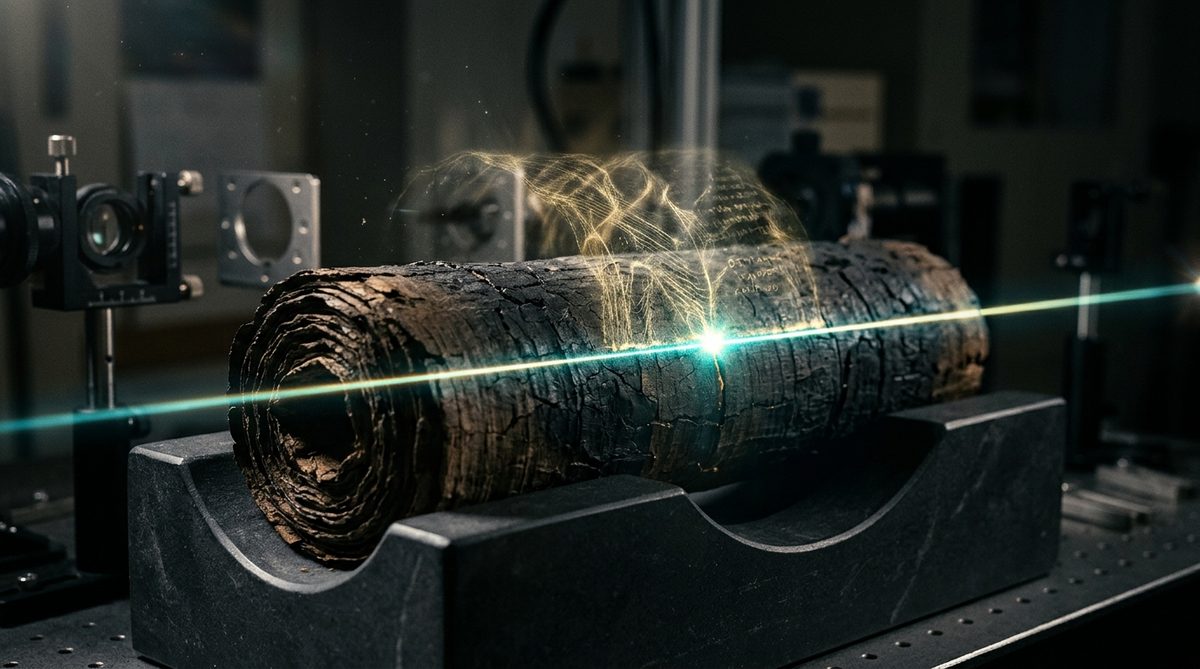
Reading black carbon ink written on black carbonized papyrus sounds impossible. The technique—pioneered over two decades by Professor Brent Seales at the University of Kentucky’s EduceLab and accelerated in 2023 when he co-founded the Vesuvius Challenge with Nat Friedman and Daniel Gross—combines physics with machine learning. First, scrolls are scanned using ultra-high-resolution phase-contrast X-ray microtomography at particle-accelerator synchrotrons: specifically the BM18 beamline at the European Synchrotron Radiation Facility (ESRF) in France and Diamond Light Source in the UK (Vesuvius Challenge). Next, AI segmentation models trace each microscopic, crumpled papyrus sheet in 3D, flatten it digitally, and spot subtle surface-texture differences where ancient reed pens left microscopic ridges of ink.
Why 600 Scrolls Are Still Sealed—and the $1 Million Open Prize
Reading one scroll end-to-end does not mean the library is unlocked overnight. In its October 2026 Open Problems roadmap, the Vesuvius Challenge explained why roughly 600 unopened scrolls remain extraordinarily difficult: many were crushed flat by volcanic debris, fusing layers together so tightly that automated segmentation still loses track of pages. To push the technology across the finish line, the challenge—which has already awarded over $2,099,250 and releases its scans openly under Creative Commons (scrollprize.org)—is offering a $1 million prize to the first person or team to decode another complete scroll within a year of the June 2026 announcement (Smithsonian Magazine).
Common Questions About the Herculaneum Scrolls :
What did the first fully decoded Herculaneum scroll (PHerc. 1667) actually say?
It preserves roughly 22 columns of a 2nd-century BC Stoic philosophical treatise on ethics, human nature, impulse, and practical wisdom, mentioning Aristocreon, the nephew and disciple of Stoic leader Chrysippus (Vesuvius Challenge).
How does AI read the Herculaneum scrolls without opening them?
Synchrotron particle accelerators capture 3D phase-contrast X-ray scans of the closed scroll, and machine-learning models digitally trace, flatten, and detect faint structural traces of carbon ink on each hidden layer (University of Kentucky).
How many Herculaneum scrolls are still unopened?
Approximately 600 carbonized scrolls from the Villa of the Papyri remain unopened today (University of Kentucky).
Can anyone still win the Vesuvius Challenge prize in 2026–2027?
Yes. Anyone can download the open Creative Commons scan datasets at scrollprize.org and compete for the $1 million prize running through mid-2027 to decode another complete scroll (Smithsonian Magazine).